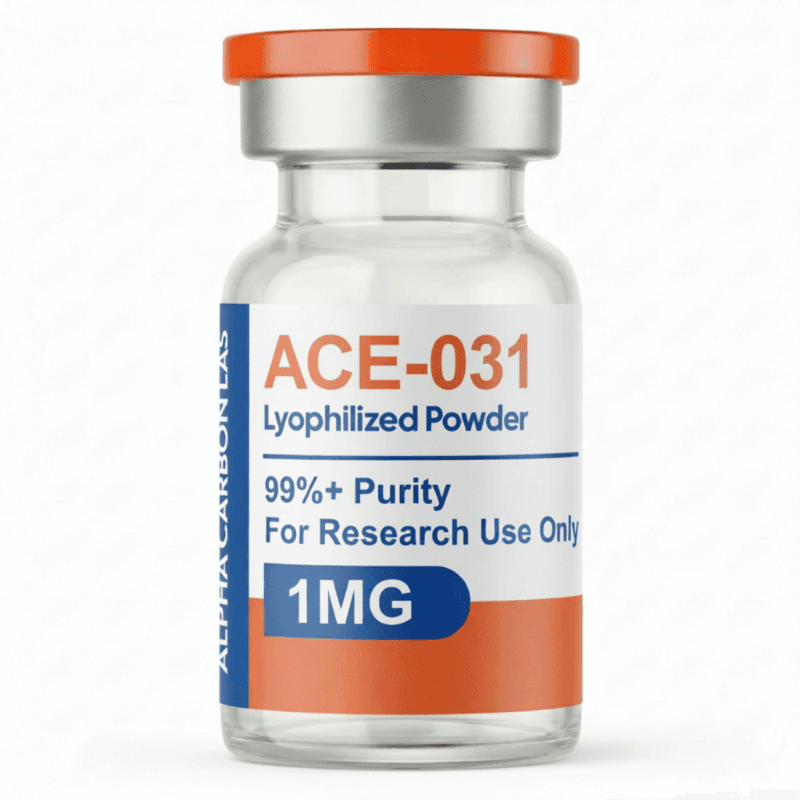
1MG
This product is for research purposes only. Not for human consumption.
Purity: >98% (HPLC verified)
Formulation: Lyophilized powder
Molecular Formula: N/A (Fusion protein)
Molecular Weight: ~58,000 g/mol
CAS Number: N/A
PubChem CID: N/A
ACE-031
Overview
ACE-031 is a soluble activin receptor type IIB (ActRIIB) fusion protein engineered as a potent myostatin inhibitor and broad-spectrum ligand trap for the TGF-β superfamily. Developed by Acceleron Pharma, ACE-031 represents a first-generation approach to pharmacological myostatin inhibition, designed to bind and neutralize myostatin and related growth-limiting proteins before they can activate cellular receptors. The fusion protein consists of the extracellular domain of the human ActRIIB receptor linked to a human IgG1 Fc domain, creating a molecule that acts as a decoy receptor in the circulation. By intercepting myostatin, GDF-11, and other members of the TGF-β superfamily that normally limit muscle growth, ACE-031 effectively removes the molecular brakes on muscle development. This mechanism allows skeletal muscle to grow beyond normal physiological limits, making it of particular interest for treating devastating muscle-wasting conditions and muscular dystrophies where patients progressively lose muscle mass and functional capacity. The compound was specifically investigated for Duchenne muscular dystrophy (DMD), a severe X-linked genetic disorder characterized by progressive muscle degeneration and weakness. While the therapeutic promise was significant, the clinical development program encountered critical safety challenges that ultimately led to its discontinuation, providing important lessons for the field of myostatin inhibition and muscle growth therapeutics.
Mechanism of Action
ACE-031 functions through a sophisticated mechanism of competitive inhibition targeting multiple negative regulators of muscle mass. The soluble ActRIIB domain has high binding affinity for myostatin (GDF-8), a member of the TGF-β superfamily that serves as a primary negative regulator of muscle growth by binding to ActRIIB receptors on muscle cell surfaces and activating SMAD2/3 signaling pathways that suppress muscle protein synthesis and promote protein degradation. By capturing myostatin in the circulation before it reaches cell-surface receptors, ACE-031 prevents the activation of these growth-inhibitory pathways. The peptide also binds GDF-11, another TGF-β family member with structural similarity to myostatin, as well as activin A and other related ligands, providing broad-spectrum inhibition of muscle growth-limiting factors. This comprehensive blockade removes multiple layers of negative regulation simultaneously, leading to dramatic activation of anabolic pathways in skeletal muscle. When myostatin signaling is blocked, satellite cells - the muscle stem cells responsible for muscle repair and growth - become activated and proliferate more readily. The mTOR (mechanistic target of rapamycin) pathway, which drives muscle protein synthesis, becomes more active. The Akt/PKB pathway, which promotes cell survival and growth while inhibiting protein breakdown through suppression of the ubiquitin-proteasome system and autophagy, is also enhanced. Additionally, myostatin inhibition reduces the expression of muscle-specific E3 ubiquitin ligases like atrogin-1 and MuRF1, which are responsible for marking muscle proteins for degradation. The net result is a profound shift in the balance between protein synthesis and degradation, favoring anabolism and leading to substantial increases in muscle fiber size (hypertrophy), potential increases in muscle fiber number (hyperplasia through satellite cell activation), and overall lean muscle mass accretion. The Fc domain of ACE-031 extends its half-life in circulation by binding to the neonatal Fc receptor (FcRn), which protects the molecule from degradation and allows for sustained myostatin inhibition from infrequent dosing.
Research Findings
The clinical research program for ACE-031 provided crucial insights into myostatin inhibition while simultaneously revealing important safety concerns that have shaped subsequent approaches to muscle growth therapeutics. Phase 1 studies in healthy volunteers demonstrated that ACE-031 could be administered safely in single ascending doses, with pharmacokinetic analysis showing dose-proportional increases in plasma levels and a half-life suitable for monthly dosing. Healthy subjects who received ACE-031 showed statistically significant increases in lean body mass and thigh muscle volume measured by MRI, with some individuals experiencing increases of several kilograms of lean mass over just a few weeks - effects far exceeding what would typically be achieved through intensive resistance training alone. These dramatic changes in muscle mass occurred without accompanying increases in muscle strength testing, raising questions about the functional quality of the rapidly accumulated muscle tissue. The pivotal Phase 2 trial enrolled boys with Duchenne muscular dystrophy, a population desperately in need of effective therapies to slow muscle degeneration. The trial design involved multiple dose levels administered subcutaneously on a monthly basis, with primary endpoints including changes in muscle mass and functional measures like the six-minute walk test and timed function tests. Early results showed promising increases in muscle volume measured by MRI and improvements in muscle thickness assessed by ultrasound across multiple muscle groups. However, the trial was prematurely terminated when an unexpected pattern of adverse events emerged across the treatment groups. Multiple participants developed nosebleeds (epistaxis), bleeding gums, and small dilated blood vessels visible on the skin surface (telangiectasias), particularly on the face and mucous membranes. These vascular side effects suggested that the broad-spectrum ActRIIB ligand-trapping approach was interfering with important vascular homeostasis functions beyond myostatin inhibition. Subsequent investigation revealed that activin and other TGF-β family members trapped by ACE-031 play crucial roles in vascular remodeling and integrity, and their inhibition led to pathological changes in blood vessel structure. The bleeding and telangiectasia issues appeared to be mechanism-based toxicities related to the non-selective nature of ActRIIB binding rather than off-target effects or manufacturing problems. Additional concerns emerged about potential effects on bone remodeling and other tissues where TGF-β signaling plays important regulatory roles. Following these safety findings, Acceleron Pharma halted the ACE-031 program in 2011. Despite the disappointing outcome, the ACE-031 research provided valuable proof-of-concept that pharmacological myostatin inhibition could produce substantial increases in muscle mass in humans, validated the ActRIIB pathway as a legitimate therapeutic target, and highlighted the critical importance of selectivity in targeting muscle growth pathways. The lessons learned from ACE-031 informed the development of subsequent myostatin inhibitors with improved selectivity profiles, including more specific anti-myostatin antibodies and modified ActRIIB constructs designed to avoid the vascular complications seen with ACE-031.
Research Applications
- Duchenne muscular dystrophy research
- Muscle wasting disorder studies
- Myostatin and GDF-11 inhibition research
- TGF-β superfamily biology studies
- Muscle growth signaling pathway research
- Sarcopenia and age-related muscle loss studies
- Muscle protein synthesis and degradation research
- Satellite cell activation studies
- ActRIIB receptor biology research
- Therapeutic muscle hypertrophy studies
- Muscle regeneration research
- Cachexia treatment research
Safety Profile
ACE-031 development was discontinued in 2011 following the identification of serious safety concerns in Phase 2 clinical trials. The primary safety issues that emerged were vascular in nature and appeared to be mechanism-based rather than off-target effects. Multiple trial participants developed epistaxis (nosebleeds), bleeding gums, and telangiectasias - small dilated blood vessels visible on the skin surface, particularly affecting the face and oral mucosa. These vascular manifestations suggested that the broad-spectrum ligand-trapping activity of ACE-031 was interfering with important physiological processes beyond myostatin inhibition. Investigation revealed that activin and other TGF-β superfamily members that are also bound by ActRIIB play critical roles in vascular homeostasis, endothelial cell function, and blood vessel remodeling. The non-selective inhibition of these pathways led to pathological changes in vascular structure and integrity. The severity and pattern of these side effects indicated they were dose-related and likely to worsen with continued or higher-dose administration. Additional theoretical concerns were raised about potential effects on bone remodeling, wound healing, and reproductive function - all processes in which TGF-β signaling plays important regulatory roles. While the muscle-building effects were dramatic and initially promising, the risk-benefit profile was deemed unacceptable, particularly for a chronic treatment in a vulnerable population of boys with muscular dystrophy. The ACE-031 experience highlighted the importance of target selectivity in muscle growth therapeutics and led to the development of more selective myostatin inhibitors, including specific anti-myostatin antibodies that do not trap other TGF-β family members. For research purposes, ACE-031 remains an important tool for studying myostatin biology and muscle growth regulation, but it is not appropriate for therapeutic use in humans. The compound demonstrates that broad-spectrum ActRIIB inhibition, while effective for muscle growth, comes with unacceptable safety liabilities that must be avoided in clinical applications.
Scientific References
Research Use Only
This product is intended for research purposes only and is not for human consumption, therapeutic use, or diagnostic applications. Please ensure compliance with all applicable regulations and institutional guidelines.