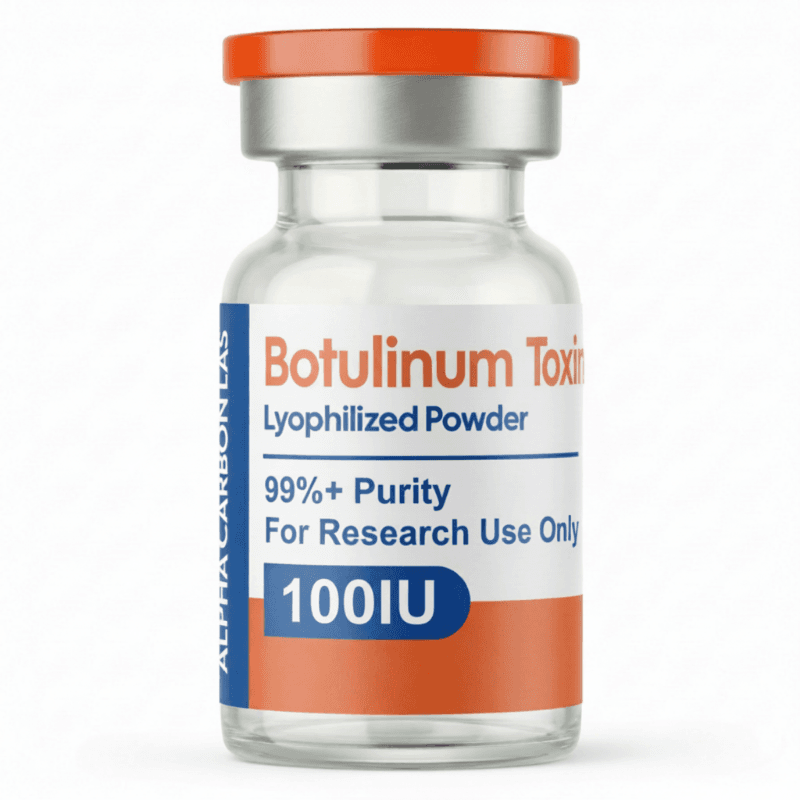
100IU
This product is for research purposes only. Not for human consumption.
Purity: >98% (HPLC verified)
Formulation: Lyophilized powder
Molecular Formula: C6760H10447N1743O2010S32
Molecular Weight: ~150,000 g/mol
CAS Number: 93384-43-1
PubChem CID: N/A
Botulinum Toxin
Overview
Botulinum toxin is a neurotoxic protein complex produced by the anaerobic bacterium Clostridium botulinum and related Clostridium species. It represents one of the most potent biological toxins known to science, with lethal doses measured in nanograms per kilogram body weight, yet through careful purification, precise dosing, and controlled administration, it has been transformed into one of the most widely used therapeutic proteins in modern medicine.
Serotypes and Clinical Applications
Seven distinct serotypes of botulinum toxin exist (designated A through G), each with slightly different structures, mechanisms, and potencies, though types A and B are the most extensively studied and clinically utilized. The therapeutic and cosmetic applications of botulinum toxin are based on its ability to cause highly localized, temporary, and reversible muscle paralysis through blockade of acetylcholine release at neuromuscular junctions.
When injected in minute quantities into specific muscles, botulinum toxin prevents nerve-stimulated muscle contraction, leading to functional muscle relaxation and atrophy that can persist for months before nerve terminals regenerate and muscle function returns.
Therapeutic Indications
This property makes it invaluable for treating conditions characterized by excessive or inappropriate muscle contraction, including focal dystonias, muscle spasticity from neurological disorders, chronic migraine through mechanisms involving pain pathway modulation, and hyperhidrosis through blockade of sympathetic cholinergic innervation of sweat glands.
Cosmetically, botulinum toxin has revolutionized aesthetic medicine through its ability to reduce the appearance of dynamic wrinkles caused by repetitive facial muscle movements, particularly in the glabellar region (frown lines), forehead, and periorbital area (crow's feet).
Clinical Development History
The history of botulinum toxin transformation from feared biological weapon to blockbuster therapeutic is remarkable - systematic research beginning in the 1970s and 1980s led to FDA approval of botulinum toxin type A for strabismus and blepharospasm in 1989, followed by approvals for cervical dystonia, axillary hyperhidrosis, chronic migraine, overactive bladder, and cosmetic indications.
Multiple commercial formulations now exist with subtle differences in potency, diffusion characteristics, and immunogenicity profiles, including onabotulinumtoxinA (Botox), abobotulinumtoxinA (Dysport), incobotulinumtoxinA (Xeomin), rimabotulinumtoxinB (Myobloc), and prabotulinumtoxinA (Jeuveau).
Mechanism of Action
Botulinum toxin exerts its paralyzing effects through a highly sophisticated multi-step process of neuronal binding, internalization, translocation, and enzymatic disruption of the neurotransmitter release machinery.
Binding and Internalization
The toxin complex consists of a neurotoxic component (approximately 150 kDa heavy chain and 50 kDa light chain linked by a disulfide bond) surrounded by associated proteins that stabilize the toxin and protect it from degradation. The mechanism begins with high-affinity binding of the toxin's heavy chain to specific receptors on the presynaptic membrane of cholinergic nerve terminals, including protein receptors such as synaptotagmin and gangliosides on the neuronal surface.
This dual-receptor binding provides specificity for nerve terminals and triggers receptor-mediated endocytosis, internalizing the toxin into synaptic vesicles within the nerve terminal.
Translocation and SNARE Cleavage
As the endocytic vesicle acidifies, the heavy chain undergoes conformational changes that create a transmembrane channel, allowing the light chain to translocate across the vesicle membrane into the neuronal cytoplasm. Once in the cytosol, the catalytically active light chain functions as a zinc-dependent endopeptidase that cleaves specific SNARE complex proteins.
Botulinum toxin type A specifically cleaves SNAP-25 (synaptosomal-associated protein of 25 kDa) at a specific peptide bond, destroying its function. SNAP-25 is an absolutely essential component of the SNARE complex, and without functional SNAP-25, synaptic vesicles cannot fuse with the presynaptic membrane, preventing the exocytosis of acetylcholine into the synaptic cleft.
Clinical Effects and Duration
The result is failure of neurotransmission at the neuromuscular junction, leading to muscle paralysis that is proportional to the amount of toxin delivered. The paralysis typically takes 24-72 hours to develop as existing SNAP-25 is gradually depleted and replaced by cleaved, non-functional protein.
The effect is reversible because neurons can synthesize new SNAP-25 and regenerate functional nerve terminals through a process called sprouting. However, this recovery process takes weeks to months, giving botulinum toxin its characteristic long duration of action (typically 3-6 months).
Research Findings
The research foundation for botulinum toxin spans decades and encompasses thousands of studies ranging from basic neuroscience elucidating its molecular mechanisms to large-scale clinical trials establishing efficacy and safety across diverse therapeutic indications.
Early Development
The journey began with research in the 1970s by Dr. Alan Scott, an ophthalmologist who pioneered the use of botulinum toxin for treating strabismus (misaligned eyes) and blepharospasm (uncontrollable eyelid spasms), demonstrating that localized injection could produce therapeutic muscle weakening without systemic toxicity. These early studies led to FDA approval in 1989 of onabotulinumtoxinA (Botox) for strabismus, blepharospasm, and hemifacial spasm.
Movement Disorders Research
For cervical dystonia (involuntary neck muscle contractions causing abnormal head postures), multiple controlled trials demonstrated that botulinum toxin significantly reduces abnormal muscle contractions, pain, and disability compared to placebo, with response rates of 60-90%. For limb spasticity resulting from stroke, traumatic brain injury, cerebral palsy, or multiple sclerosis, extensive research has established efficacy in reducing muscle tone and improving function.
Migraine and Hyperhidrosis
Studies in chronic migraine, culminating in the landmark PREEMPT trials that enrolled over 1,300 patients, demonstrated that standardized injections of botulinum toxin significantly reduced headache days, migraine episodes, and headache-related disability, leading to FDA approval for chronic migraine in 2010.
Research into hyperhidrosis (excessive sweating) showed that intradermal botulinum toxin injections block acetylcholine release from sympathetic nerve terminals that innervate sweat glands, dramatically reducing sweat production for 6-12 months with response rates approaching 80-95%.
Aesthetic Applications
In the aesthetic domain, research has established efficacy for reducing dynamic facial wrinkles through temporary relaxation of hyperactive facial muscles. Studies show that botulinum toxin injections can smooth frown lines for 3-4 months with high patient satisfaction.
Safety Profile
Safety research has been extensive, with millions of treatment sessions worldwide providing robust data on adverse event profiles. When administered by trained practitioners using approved doses and techniques, botulinum toxin has an excellent safety record with mostly localized and transient side effects.
Research Applications
- Neuromuscular disorder research and treatment
- Focal dystonia and movement disorder studies
- Muscle spasticity treatment research
- Chronic migraine prevention studies
- Hyperhidrosis (excessive sweating) treatment research
- Cosmetic dermatology and aesthetic medicine research
- Overactive bladder and urinary incontinence studies
- Pain management and chronic pain research
- Facial rejuvenation and wrinkle reduction studies
- Neurological rehabilitation research
- Blepharospasm and hemifacial spasm treatment
- Cervical dystonia research
- Strabismus correction studies
- Bruxism and TMJ disorder research
- Depression and mood disorder studies (emerging)
Safety Profile
Botulinum toxin has an extensively documented safety profile based on decades of clinical use, millions of treatment sessions worldwide, and rigorous post-marketing surveillance across multiple approved indications. When administered by properly trained healthcare professionals using approved formulations, appropriate doses, and correct injection techniques, botulinum toxin therapy demonstrates excellent safety with serious adverse events being exceedingly rare. The most common side effects are localized, temporary, and directly related to the injection procedure or localized toxin effects: injection site pain, bruising, erythema, and swelling occur frequently but resolve within days. Headache is reported in a significant minority of patients, particularly after cosmetic treatments, though distinguishing treatment-related headache from coincidental or pre-existing headaches can be challenging. The most concerning local adverse event is unintended weakness of muscles adjacent to the injection site due to local diffusion of toxin, manifesting as ptosis (eyelid drooping) with periocular injections, dysphagia (swallowing difficulty) with neck injections, or asymmetry with cosmetic facial treatments - these effects are temporary, typically resolving within weeks to months as nerve terminals regenerate, but can cause significant distress and functional impairment during their duration. Systemic effects from spread of toxin beyond the injection site are possible but rare with approved doses, including generalized weakness, dysphagia, dysarthria (speech difficulties), respiratory compromise, and very rarely, life-threatening respiratory failure requiring mechanical ventilation. These systemic effects are more likely in patients with pre-existing neuromuscular disorders (myasthenia gravis, Lambert-Eaton syndrome, amyotrophic lateral sclerosis), very young children, or when excessive doses are administered. The FDA issued boxed warnings regarding potential for systemic spread, though serious events remain very uncommon in clinical practice with proper patient selection and dosing. Immunogenicity - the development of neutralizing antibodies that render subsequent treatments ineffective - has been a concern throughout botulinum toxin's clinical history. Older formulations with higher complexing protein content had higher immunogenicity rates, but modern purified formulations have dramatically reduced this risk to 1-3% or less with standard dosing regimens. Factors that increase antibody formation risk include high doses, frequent treatments (booster injections less than 3 months apart), and possibly individual genetic factors affecting immune response. Once neutralizing antibodies develop, patients lose responsiveness to that toxin serotype, though switching to a different serotype may restore efficacy. Contraindications include known hypersensitivity to botulinum toxin or albumin, infection at the injection site, and for bladder injections, urinary tract infection. Relative contraindications include neuromuscular disorders, concurrent aminoglycoside or other drugs that interfere with neuromuscular transmission, pregnancy and breastfeeding (FDA Pregnancy Category C due to lack of adequate human data, though animal studies and case reports suggest low risk), and bleeding disorders or anticoagulant use due to injection site bleeding risk. Long-term safety data spanning decades of use for approved indications shows no evidence of cumulative toxicity, carcinogenicity, or permanent effects on nerve function with repeated treatments according to approved dosing intervals. The reversibility of botulinum toxin effects provides an inherent safety feature - even in cases of adverse effects, full recovery is expected as nerve terminals regenerate. Overall, when used appropriately, botulinum toxin ranks among the safest therapeutic proteins in medicine, with a risk-benefit profile that has supported its approval for numerous medical and cosmetic indications and its widespread adoption in clinical practice.
Scientific References
Research Use Only
This product is intended for research purposes only and is not for human consumption, therapeutic use, or diagnostic applications. Please ensure compliance with all applicable regulations and institutional guidelines.