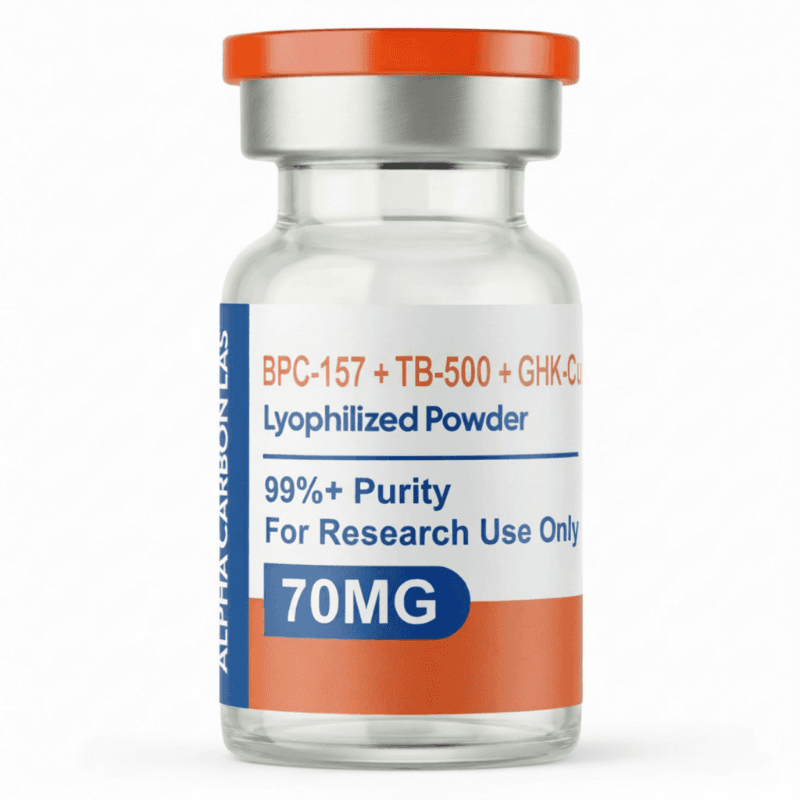
70mg (10mg/10mg/50mg)
This product is for research purposes only. Not for human consumption.
Purity: >99% (HPLC verified)
Formulation: Lyophilized powder blend
Molecular Formula: C62H98N16O22 + C212H350N56O78S + C14H24N6O4Cu
Molecular Weight: 1419.5 + 4963 + 403.9 g/mol
CAS Number: 137525-51-0 / 77591-33-4 / 49557-75-7
PubChem CID: 9941957 / 16132341 / 3014738
BPC-157 + TB-500 + GHK-Cu Blend
Overview
The BPC-157 + TB-500 + GHK-Cu Blend represents a comprehensive regenerative peptide formulation combining three distinct bioactive compounds with complementary mechanisms of action. This triple-peptide blend brings together BPC-157's tissue protective and healing properties, TB-500's cell migration and remodeling capabilities, and GHK-Cu's powerful effects on extracellular matrix regeneration and gene expression modulation.
GHK-Cu (Glycyl-L-Histidyl-L-Lysine-Copper) is a naturally occurring copper-binding tripeptide found in human plasma, saliva, and urine. Its concentration decreases significantly with age, from approximately 200 ng/mL at age 20 to 80 ng/mL by age 60. GHK-Cu has demonstrated remarkable effects on wound healing, skin remodeling, hair growth, and gene expression affecting tissue repair.
This triple blend addresses tissue regeneration from multiple angles: BPC-157 optimizes vascularization and reduces inflammation, TB-500 facilitates cellular migration and tissue organization, and GHK-Cu promotes extracellular matrix synthesis and activates genes associated with tissue remodeling and repair.
Mechanism of Action
The triple blend operates through three distinct but synergistic mechanistic pathways that together provide comprehensive regenerative support.
BPC-157 Pathways
BPC-157 promotes angiogenesis via VEGF upregulation, modulates the nitric oxide system for optimal tissue perfusion, enhances expression of growth factors (FGF, EGF, TGF-β), and exhibits potent anti-inflammatory activity through cytokine modulation. It protects cells from oxidative stress and supports mitochondrial function.
TB-500 Pathways
TB-500 regulates actin polymerization through G-actin sequestration, enabling enhanced cellular migration essential for wound repair. It activates the Akt survival pathway, recruits stem cells to injury sites, promotes endothelial cell differentiation for angiogenesis, and upregulates matrix metalloproteinases for tissue remodeling.
GHK-Cu Pathways
GHK-Cu functions through multiple mechanisms: it stimulates collagen synthesis (types I and III) and elastin production; activates decorin expression for proper collagen organization; promotes glycosaminoglycan synthesis including hyaluronic acid and dermatan sulfate; attracts immune cells and macrophages to injury sites; exhibits antioxidant and anti-inflammatory properties; and modulates expression of thousands of genes, with studies showing it resets gene expression patterns toward a healthier, more youthful profile. The copper ion serves as a cofactor for lysyl oxidase essential for collagen crosslinking and tissue strength.
Synergistic Integration
Together, these three peptides address the complete regeneration cascade: initial response and inflammation control (BPC-157), cellular migration and reorganization (TB-500), and extracellular matrix synthesis and maturation (GHK-Cu).
Research Findings
The triple blend combines three well-researched peptides, each with substantial independent research support. The rationale for combination builds upon the documented mechanisms of each component.
GHK-Cu Research Foundation
Research by Dr. Loren Pickart and colleagues established GHK-Cu's role in wound healing and tissue remodeling. Studies demonstrated that GHK-Cu accelerates wound contraction and epithelialization, with research published in the Journal of Biomaterials Science showing enhanced healing of diabetic wounds. Gene expression studies revealed that GHK-Cu modulates over 4,000 human genes, with 50% moving toward patterns seen in younger, healthier individuals.
Skin aging research has shown GHK-Cu stimulates collagen production by up to 70% in fibroblast cultures. Studies on hair growth demonstrated GHK-Cu enlarges hair follicles and increases follicle size, leading to commercial applications in hair growth formulations.
Component Synergy Research
Research into BPC-157 and TB-500 individually demonstrates their complementary mechanisms - BPC-157's vascular and protective effects pair with TB-500's cellular migration capabilities. Adding GHK-Cu introduces powerful matrix synthesis and gene modulation effects. While controlled studies of the specific triple combination are limited, the mechanistic rationale is strong: each peptide addresses distinct aspects of the regeneration process.
Clinical Development
GHK-Cu has progressed into clinical applications for skin care and wound healing, with commercially available formulations. This clinical validation provides additional confidence in its safety and efficacy profile within the blend.
Research Applications
- Comprehensive tissue regeneration research
- Wound healing and scar reduction studies
- Skin remodeling and anti-aging research
- Collagen and extracellular matrix studies
- Musculoskeletal injury healing research
- Hair follicle and growth research
- Post-surgical tissue repair studies
- Gene expression modulation research
- Inflammation and tissue protection studies
- Connective tissue synthesis research
Safety Profile
The safety profile of the triple blend is informed by the individual safety data of each component. BPC-157 has demonstrated excellent tolerability across numerous preclinical studies with no significant adverse effects even at high doses. TB-500, as a synthetic form of the endogenous Thymosin Beta-4, has shown good tolerability in research applications. GHK-Cu has the most extensive human safety data of the three, with years of use in cosmetic and wound-healing applications demonstrating a favorable safety profile. The copper-binding tripeptide delivers copper in physiological amounts and is well-tolerated topically and in wound applications. However, comprehensive safety data for the specific triple combination in humans is limited. As with other peptide blends, no large-scale clinical trials have evaluated the combination. Theoretical considerations regarding cell proliferation effects should be considered. This blend is intended solely for research purposes and is not approved for therapeutic use.
Scientific References
Research Use Only
This product is intended for research purposes only and is not for human consumption, therapeutic use, or diagnostic applications. Please ensure compliance with all applicable regulations and institutional guidelines.