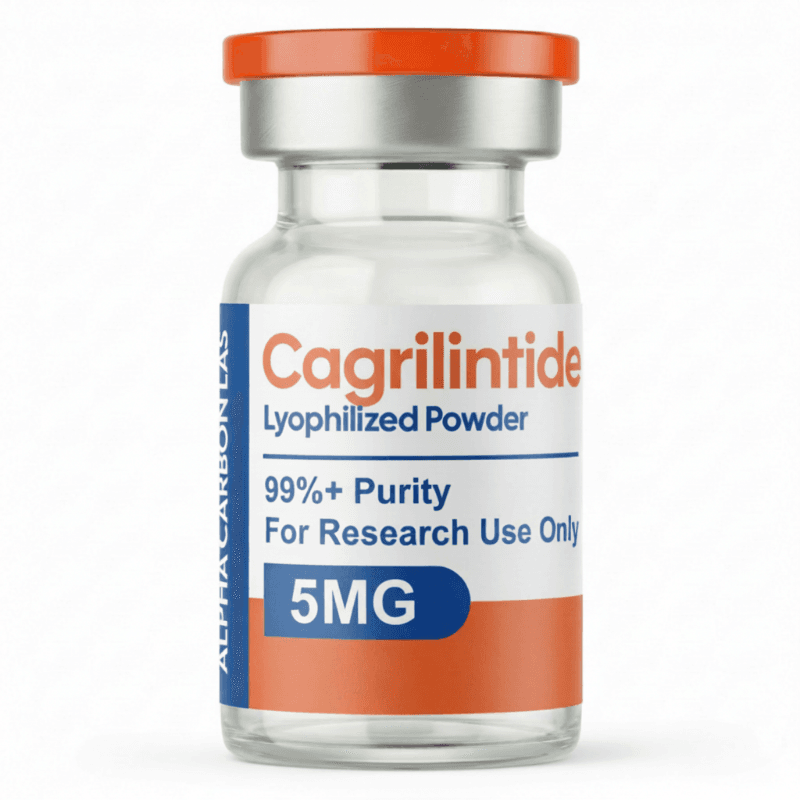
5MG
This product is for research purposes only. Not for human consumption.
Purity: >98% (HPLC verified)
Formulation: Lyophilized powder
Molecular Formula: C171H265N45O53S2
Molecular Weight: 3912.4 g/mol
CAS Number: N/A
PubChem CID: N/A
Cagrilintide
Overview
Cagrilintide is a long-acting acylated amylin analog being developed by Novo Nordisk as a novel anti-obesity and diabetes medication that harnesses the metabolic regulatory functions of amylin, an often-overlooked pancreatic hormone. Amylin, also known as islet amyloid polypeptide (IAPP), is a 37-amino acid peptide hormone that is co-secreted with insulin from pancreatic beta cells in response to nutrient intake, particularly meals containing glucose and amino acids. Despite being discovered decades ago, amylin has received less attention than insulin, glucagon, and incretin hormones, yet it plays critical complementary roles in regulating glucose homeostasis, energy balance, and body weight. Native amylin acts primarily through receptors in the brain, particularly in the area postrema of the hindbrain, where it suppresses appetite, induces satiety, and slows gastric emptying. It also inhibits postprandial glucagon secretion, helping to prevent excessive hepatic glucose production after meals. These complementary effects to insulin make amylin an attractive therapeutic target for obesity and type 2 diabetes. However, native amylin has several limitations as a therapeutic agent: it has a very short half-life requiring multiple daily injections, it has poor solubility and a tendency to aggregate and form amyloid fibrils (which is actually implicated in beta cell dysfunction in type 2 diabetes), and its pharmacokinetic properties are suboptimal for convenient patient use. Cagrilintide was engineered to overcome these limitations while maintaining amylin agonist activity. The molecule has been modified through amino acid substitutions that prevent aggregation and amyloid formation, and it has been acylated with a fatty acid side chain that enables binding to albumin in the bloodstream, dramatically extending its half-life to allow for once-weekly subcutaneous administration. This makes it compatible with the dosing regimens of other once-weekly metabolic therapies like semaglutide. Cagrilintide produces dose-dependent weight loss and improvements in glycemic control in clinical trials, and it has shown particularly impressive results when combined with GLP-1 receptor agonists, suggesting synergistic effects between amylin and incretin pathways. The development of cagrilintide represents part of a broader trend toward combination metabolic therapies that target multiple complementary pathways simultaneously to achieve superior weight loss and glycemic benefits compared to single-agent approaches.
Mechanism of Action
Cagrilintide exerts its metabolic effects through activation of amylin receptors, which are complexes consisting of the calcitonin receptor (CTR) paired with receptor activity-modifying proteins (RAMPs), particularly RAMP1, RAMP2, and RAMP3. These heterodimeric complexes are expressed in several brain regions including the area postrema, nucleus tractus solitarius, and ventromedial hypothalamus, which are critical areas for regulating appetite, satiety, and energy balance. When cagrilintide activates these amylin receptors in the hindbrain, it triggers several physiological responses that contribute to weight loss and metabolic improvement. First, the peptide produces satiety signals that reduce appetite and food intake. This occurs through amylin receptor-mediated activation of neurons in the area postrema and nucleus tractus solitarius that project to higher brain regions including the hypothalamus, where they interact with melanocortin and other appetite-regulatory circuits. Subjects treated with cagrilintide report earlier feelings of fullness during meals and reduced overall hunger between meals, leading to decreased caloric intake without the aversive effects associated with some appetite suppressants. Second, cagrilintide slows gastric emptying - the rate at which food leaves the stomach and enters the small intestine. This gastric slowing contributes to satiety by prolonging the sensation of fullness after eating, and it also attenuates postprandial glucose excursions by reducing the rate at which glucose from meals enters the bloodstream. This effect is particularly beneficial for people with diabetes who experience dangerously high blood glucose spikes after eating. Third, cagrilintide suppresses inappropriately elevated glucagon secretion, particularly the postprandial glucagon elevation seen in type 2 diabetes. Glucagon is a counterregulatory hormone that stimulates hepatic glucose production, and its excessive secretion after meals contributes to postprandial hyperglycemia in diabetes. By suppressing glucagon, cagrilintide helps reduce hepatic glucose output and improve glycemic control. The mechanisms of glucagon suppression appear to involve both direct effects on pancreatic alpha cells and indirect effects mediated through the central nervous system. Fourth, cagrilintide may have effects on energy expenditure, though these are less well-characterized than its effects on appetite and gastric function. Some preclinical data suggest amylin receptor activation can influence thermogenesis and metabolic rate. The acylation of cagrilintide with a fatty acid moiety enables reversible binding to albumin in plasma, creating an albumin-bound reservoir of peptide that slowly releases active drug over time. This extends the elimination half-life to approximately 5-7 days, enabling once-weekly dosing. The pharmacokinetics show relatively stable plasma levels between doses after steady-state is achieved, providing consistent amylin receptor activation throughout the dosing interval. Importantly, cagrilintide does not directly affect insulin secretion or insulin sensitivity, but by reducing food intake, promoting weight loss, and improving glycemic control, it can indirectly improve insulin sensitivity through weight loss-mediated mechanisms.
Research Findings
The clinical development program for cagrilintide has progressed through multiple phases with increasingly encouraging results, particularly for combination therapy approaches. Early Phase 1 studies in healthy volunteers and patients with obesity or type 2 diabetes established proof-of-concept, demonstrating dose-dependent reductions in food intake, body weight, and glucose levels with acceptable tolerability. Gastrointestinal side effects including nausea and vomiting were observed, as expected for agents that slow gastric emptying, but these were generally transient and manageable with dose escalation strategies. Phase 2a trials specifically evaluated cagrilintide monotherapy in people with obesity and type 2 diabetes. A 26-week trial showed that the highest doses of cagrilintide produced approximately 9-10% body weight reductions compared to placebo, which is clinically meaningful and comparable to other weight loss medications. Glycemic control improvements were also observed in participants with diabetes. However, the most exciting results have come from combination therapy trials pairing cagrilintide with semaglutide, a GLP-1 receptor agonist that is itself a highly effective weight loss and glucose-lowering agent. The rationale for this combination is that amylin and GLP-1 pathways are complementary but mechanistically distinct, potentially allowing for additive or synergistic effects. Phase 2b trials testing various dose combinations of cagrilintide plus semaglutide have demonstrated truly remarkable weight loss results - some participants achieved average weight reductions exceeding 15-17% of baseline body weight over 32-48 weeks, placing this combination among the most effective pharmacological obesity treatments tested to date, rivaling or exceeding bariatric surgery results in some cases. These dramatic weight loss effects appeared to reflect true synergy between the two agents rather than simple additive effects. Mechanistically, the combination targets multiple nodes of appetite and metabolic regulation: GLP-1 receptor activation in the hypothalamus and brainstem reduces appetite and slows gastric emptying while also enhancing insulin secretion and insulin sensitivity; amylin receptor activation provides complementary satiety signals through partially distinct neural circuits, glucagon suppression, and additional gastric slowing. The two pathways converge on common downstream circuits controlling energy balance, potentially explaining the synergistic weight loss. Ongoing Phase 3 trials (part of development programs with names like CagriSema for the combination product) are evaluating cagrilintide combinations in larger populations with obesity and type 2 diabetes. Preliminary results continue to show impressive weight loss and metabolic improvements, with safety profiles characterized primarily by gastrointestinal effects that are manageable with appropriate dose titration. If these Phase 3 programs are successful, cagrilintide in combination with GLP-1 agonists could represent a new standard of care for obesity and type 2 diabetes treatment, offering weight loss approaching that of bariatric surgery through pharmacological means. Beyond combination therapy, research continues to explore cagrilintide monotherapy for patients who cannot tolerate GLP-1 agonists and to investigate its potential applications in other metabolic conditions including metabolic-associated steatohepatitis (MASH) and cardiovascular disease prevention. The success of cagrilintide has reinvigorated interest in amylin biology and positioned amylin pathway activation as a key component of next-generation combination metabolic therapies.
Research Applications
- Obesity treatment research
- Type 2 diabetes studies
- Amylin pathway research
- Appetite regulation studies
- Combination therapy research
- Metabolic syndrome studies
Safety Profile
Cagrilintide safety has been evaluated in multiple Phase 1, 2, and ongoing Phase 3 clinical trials involving thousands of participants with obesity and/or type 2 diabetes, with an overall safety profile that is manageable and generally consistent with what would be expected for an amylin analog that slows gastric emptying and affects appetite regulation. The most common adverse events are gastrointestinal in nature, reflecting the peptide's mechanisms of action. Nausea is the most frequently reported side effect, occurring in a substantial proportion of participants particularly during dose escalation, with incidence rates typically ranging from 40-60% depending on the dose and titration schedule. The nausea is generally most pronounced in the first few weeks of treatment and tends to improve over time as physiological tolerance develops, with the majority of affected individuals able to continue treatment. Vomiting has been reported less frequently than nausea but still occurs in a meaningful proportion of participants (typically 10-30% depending on dose). Diarrhea, constipation, dyspepsia, abdominal pain, and decreased appetite are other gastrointestinal effects that have been documented. The gastrointestinal tolerability profile can be significantly improved through slow, gradual dose titration over several weeks, starting with low doses and incrementally increasing, which allows the body to adapt to gastric slowing effects. Studies have shown that slower titration schedules reduce the incidence and severity of GI adverse events while still achieving target therapeutic doses. Most gastrointestinal adverse events are mild to moderate in severity and transient, though a subset of participants discontinue treatment due to GI intolerance - discontinuation rates due to adverse events in Phase 2 trials have ranged from approximately 5-15% for cagrilintide monotherapy. When cagrilintide is combined with GLP-1 receptor agonists like semaglutide (both of which slow gastric emptying and cause GI effects), there is potential for additive gastrointestinal adverse events, and indeed, combination therapy trials have reported somewhat higher rates of nausea and vomiting compared to either agent alone. However, the GI effects remain manageable for most participants with appropriate dose titration, and the remarkable weight loss efficacy seen with combinations has provided strong motivation for patients and providers to work through the tolerability challenges. Beyond gastrointestinal effects, other adverse events that have been monitored include injection site reactions (generally mild), headache, fatigue, and dizziness. Hypoglycemia (dangerously low blood sugar) risk appears low with cagrilintide monotherapy because amylin does not directly stimulate insulin secretion, though hypoglycemia risk may be increased when cagrilintide is combined with insulin or sulfonylureas in people with diabetes - appropriate dose adjustments of concomitant glucose-lowering medications are recommended. Cardiovascular safety assessment is a critical component of obesity and diabetes drug development given the cardiovascular risk profiles of these populations. Preliminary cardiovascular safety data from Phase 2 trials have not revealed concerning signals, with improvements in blood pressure, lipid profiles, and inflammatory markers observed alongside the weight loss and metabolic improvements. However, comprehensive cardiovascular outcomes trials (CVOTs) would typically be required for definitive cardiovascular safety and efficacy evaluation, and these studies may be ongoing or planned. Effects on heart rate, which can be affected by incretin-based therapies, have been monitored without major concerns identified to date. Pancreatitis, a rare but serious adverse event that has been associated with incretin-based therapies and is monitored carefully in metabolic drug development, has not emerged as a significant safety signal in cagrilintide trials based on available data, though continued vigilance is warranted. Gallbladder-related events including cholelithiasis (gallstones) and cholecystitis (gallbladder inflammation) are potential concerns with rapid weight loss from any cause, and these have been reported in some participants receiving cagrilintide, consistent with weight loss-associated risks seen with other obesity medications and bariatric surgery. Mental health and suicidality monitoring has become standard in obesity drug development following concerns raised with some historical obesity medications, and depression and suicidal ideation are assessed in cagrilintide trials, without concerning signals identified to date based on available data. Long-term safety beyond the 1-2 year duration of current trials remains to be fully characterized, particularly regarding sustained gastric effects, potential nutritional implications of chronic gastric slowing, and any cumulative toxicities. As with other peptide therapeutics, immunogenicity (antibody formation against the drug) is monitored, with low rates of treatment-emergent anti-drug antibodies reported and no apparent impact on efficacy or safety when antibodies do develop. Use in pregnancy is not recommended due to insufficient safety data, and contraception is advised for women of childbearing potential during treatment. Renal and hepatic impairment effects on pharmacokinetics and safety are being characterized, with dose adjustments potentially needed in some populations.
Scientific References
Research Use Only
This product is intended for research purposes only and is not for human consumption, therapeutic use, or diagnostic applications. Please ensure compliance with all applicable regulations and institutional guidelines.