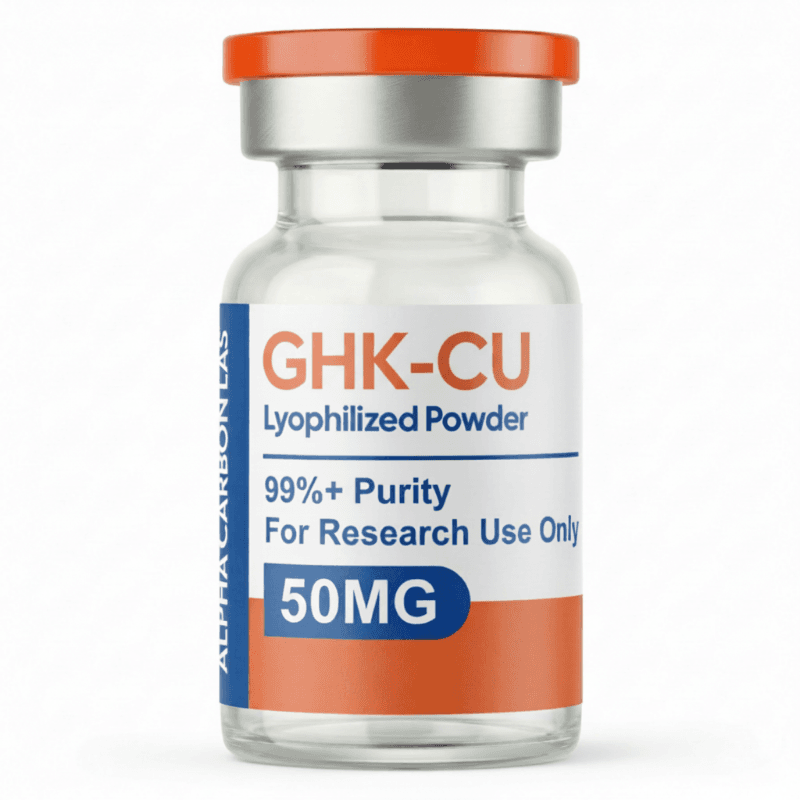
50MG
This product is for research purposes only. Not for human consumption.
Purity: >98% (HPLC verified)
Formulation: Lyophilized powder
Molecular Formula: C14H22CuN6O4
Molecular Weight: 401.91 g/mol
CAS Number: 49557-75-7
PubChem CID: N/A
GHK-CU
Overview
GHK-Cu (Glycyl-L-Histidyl-L-Lysine-Copper) is a naturally occurring tripeptide-copper complex with the amino acid sequence Gly-His-Lys that demonstrates extraordinary regenerative, protective, and anti-aging properties across multiple tissue types and biological systems. First isolated from human plasma by Loren Pickart in 1973 during research on components that could stimulate liver regeneration, GHK was initially recognized for its ability to promote tissue repair and remodeling.
Subsequent research revealed that GHK has exceptionally high binding affinity for copper ions (Cu²⁺), forming a stable chelate complex (GHK-Cu) that is the biologically active form responsible for the peptide's remarkable effects.
Age-Related Decline
In the body, GHK-Cu naturally occurs at concentrations of approximately 200 ng/mL in plasma at age 20, but these levels decline progressively with age to less than 80 ng/mL by age 60 - this age-related decline correlates with decreased tissue repair capacity, skin aging, and impaired regenerative responses, leading to the hypothesis that GHK-Cu decline contributes to aging phenotypes and that restoration of youthful levels through supplementation could have anti-aging benefits.
Diverse Biological Activities
The peptide's biological activities are remarkably diverse and include stimulation of collagen and glycosaminoglycan synthesis (critical for skin, connective tissue, and wound healing), activation of wound healing mechanisms, promotion of blood vessel formation (angiogenesis) to support tissue repair and regeneration, anti-inflammatory effects that resolve excessive inflammation while supporting beneficial healing responses, antioxidant and protective effects against oxidative damage and toxic compounds, attraction of immune and repair cells to sites of injury, remodeling of extracellular matrix through regulated metalloproteinase activity, stimulation of nerve outgrowth and regeneration, and even modulation of gene expression in patterns that reverse age-related changes and restore more youthful cellular function.
Commercial and Therapeutic Applications
These multifaceted effects have positioned GHK-Cu as one of the most studied and commercially successful peptides in cosmetic dermatology and aesthetic medicine, with incorporation into hundreds of skincare products and professional aesthetic treatments over the past several decades. Beyond cosmetics, research has explored GHK-Cu's potential in therapeutic wound healing (chronic wounds, surgical recovery, diabetic ulcers), hair restoration, tissue engineering, nerve regeneration, lung disease, and even systemic anti-aging interventions.
The peptide's natural occurrence in the body, well-established safety profile from decades of topical use and clinical research, and remarkable breadth of beneficial biological effects make it a compelling example of a naturally derived regenerative peptide with both proven cosmetic applications and ongoing exploration of broader therapeutic potential. The copper component is essential for activity - copper is a critical cofactor for numerous enzymes involved in collagen cross-linking (lysyl oxidase), antioxidant defense (superoxide dismutase), wound healing, and tissue remodeling, and GHK functions as a highly effective copper delivery system that facilitates copper uptake into cells and tissues where it can support these essential enzymatic processes.
Mechanism of Action
GHK-Cu exerts its diverse regenerative and protective effects through multiple interconnected molecular and cellular mechanisms.
Copper Chelation and Delivery
At the most fundamental level, GHK functions as a copper chelator and delivery system - the tripeptide binds Cu²⁺ with exceptionally high affinity (binding constant approximately 10¹⁶ M⁻¹, among the highest known for biological copper chelators), forming a square planar coordination complex where the copper ion is coordinated by the nitrogen atoms of the terminal amino group, the two peptide bonds, and the imidazole nitrogen of histidine.
This chelation dramatically enhances copper bioavailability and facilitates cellular copper uptake through mechanisms that may involve cell-surface receptors and endocytic pathways. Once delivered into cells, copper can be incorporated into copper-dependent enzymes critical for tissue repair and regeneration.
Enzyme Activation
Lysyl oxidase, the enzyme responsible for cross-linking collagen and elastin fibers (essential for tissue strength, elasticity, and proper matrix organization), absolutely requires copper as a cofactor - GHK-Cu enhances lysyl oxidase activity by ensuring adequate copper availability, thereby promoting proper collagen and elastin maturation and tissue structural integrity. Superoxide dismutase (SOD), a critical antioxidant enzyme that neutralizes harmful superoxide radicals, also requires copper, and GHK-Cu supports antioxidant defenses through this pathway.
Extracellular Matrix Synthesis
Beyond copper delivery, GHK-Cu directly stimulates synthesis of extracellular matrix components. Research has demonstrated that GHK-Cu treatment increases production of collagen (particularly type I and type III collagen, the predominant structural collagens in skin and connective tissues), glycosaminoglycans (including hyaluronic acid, which provides hydration, volume, and biochemical signaling in skin), decorin (a small proteoglycan involved in collagen fibril organization and growth factor regulation), and other matrix molecules critical for tissue structure and function.
Matrix Metalloproteinase Modulation
GHK-Cu potently modulates the activity of matrix metalloproteinases (MMPs), a family of enzymes that degrade extracellular matrix components - while this might seem counterproductive for regeneration, controlled MMP activity is actually essential for proper tissue remodeling, removing damaged matrix to allow replacement with newly synthesized healthy matrix. GHK-Cu appears to promote balanced remodeling, suppressing excessive MMP activity that occurs in chronic wounds and aging skin while supporting appropriate remodeling necessary for wound healing and tissue renewal.
Gene Expression Effects
GHK-Cu demonstrates powerful effects on gene expression, with studies showing it can modulate expression of hundreds to thousands of genes involved in tissue repair, oxidative stress responses, cell proliferation, protein synthesis, and cellular function. Remarkably, gene expression profiling studies have shown that GHK-Cu treatment can shift aged fibroblasts toward more youthful gene expression patterns, reversing age-related changes in gene activity related to collagen production, matrix remodeling, inflammatory responses, and cellular senescence.
Angiogenesis and Anti-Inflammatory Effects
GHK-Cu promotes angiogenesis - the formation of new blood vessels - which is critical for delivering oxygen and nutrients to healing or regenerating tissues. This pro-angiogenic effect involves stimulation of vascular endothelial growth factor (VEGF) production and activation of endothelial cells to proliferate, migrate, and form new capillary networks.
The peptide exhibits anti-inflammatory properties by modulating cytokine production, reducing excessive inflammatory mediators like TNF-α and IL-6 while supporting resolution of inflammation and transition to tissue repair phases. GHK-Cu also demonstrates chemoattractant properties, recruiting immune cells, fibroblasts, and other repair cells to sites of injury where they are needed.
Research Findings
Research on GHK-Cu spans over five decades and encompasses in vitro cell culture studies, animal models of wound healing and aging, human clinical trials in dermatology and wound care, and extensive real-world experience from commercial cosmetic applications.
Foundational Research
The foundational research by Loren Pickart in the 1970s and 1980s established GHK's tissue repair properties and led to the development of copper peptide skincare products. Early wound healing studies demonstrated that GHK-Cu application to experimental wounds in animals accelerated healing, increased collagen deposition, enhanced wound breaking strength, improved tissue organization, and reduced scarring compared to controls. These effects were dose-dependent and required the copper complex (GHK without copper showed minimal effects).
Human Wound Healing Research
Human wound healing research has explored GHK-Cu in various contexts. Studies in surgical wounds showed that topical GHK-Cu application reduced healing time, improved cosmetic outcomes, and decreased scar formation. Research in chronic venous leg ulcers (notoriously difficult to heal) demonstrated that GHK-Cu treatment could accelerate closure and improve healing outcomes in this challenging patient population. Diabetic wound healing studies showed beneficial effects, potentially helping address the impaired healing that complicates diabetes management.
Dermatology and Cosmetic Research
The dermatology and cosmetic research on GHK-Cu is extensive. Multiple clinical trials in photoaged skin (sun damage) have shown that topical GHK-Cu formulations improve skin appearance including reductions in fine lines and wrinkles, improvement in skin firmness and elasticity, enhancement of skin texture and smoothness, increase in skin thickness (reversing age-related dermal atrophy), improvement in skin clarity and reduction in hyperpigmentation, and overall rejuvenated appearance.
Histological analysis of skin biopsies from GHK-Cu-treated subjects has confirmed increases in collagen density, normalization of elastin structure, improvement in dermal architecture, and increased glycosaminoglycan content - objective evidence of tissue-level improvements beyond subjective appearance.
Hair Growth Research
Hair growth research has demonstrated that GHK-Cu can stimulate hair follicle growth, increase hair thickness, and potentially support hair restoration in androgenetic alopecia and other hair loss conditions. Mechanisms may involve enhancement of follicle stem cell activity, improvement of follicle vascularization, and anti-inflammatory effects on the follicle microenvironment.
Gene Expression Studies
Gene expression studies using microarray and genomic profiling have provided molecular insights into GHK-Cu's mechanisms. Studies by Pickart and colleagues published in 2012-2018 showed that GHK-Cu treatment of cultured human fibroblasts altered expression of several thousand genes, with patterns indicating increased expression of genes involved in tissue repair, antioxidant responses, protein synthesis, and cellular rejuvenation. Remarkably, treatment of aged fibroblasts with GHK-Cu shifted their gene expression profiles toward patterns resembling younger cells, suggesting potential for reversing aspects of cellular aging.
Nerve regeneration research has demonstrated that GHK-Cu promotes neurite outgrowth and nerve repair in experimental models, suggesting potential applications in peripheral nerve injury and neurodegenerative conditions. Lung disease research has explored GHK-Cu for idiopathic pulmonary fibrosis and COPD, with animal studies showing reduced fibrosis and improved lung function.
Research Applications
- Skin rejuvenation and anti-aging dermatology research
- Wound healing and tissue repair studies (acute and chronic wounds)
- Collagen and extracellular matrix synthesis research
- Cosmetic applications and skincare product development
- Hair growth stimulation and alopecia treatment research
- Scar reduction and prevention studies
- Gene expression modulation and cellular aging research
- Matrix metalloproteinase regulation research
- Angiogenesis and tissue vascularization studies
- Antioxidant and protective mechanisms research
- Nerve regeneration and neuroprotection studies
- Lung disease and fibrosis research
- Copper delivery and bioavailability research
- Tissue engineering and regenerative medicine applications
Safety Profile
GHK-Cu has an exceptional safety profile based on over 50 years of research use, extensive incorporation into hundreds of commercial cosmetic products used by millions of consumers, and clinical trial experience. As a naturally occurring peptide found in human plasma, GHK-Cu represents a physiological component of the body's own repair systems, which contributes to its safety - the body already has mechanisms to handle this compound, reducing the likelihood of serious adverse reactions. Topical application, the most common route of use, has demonstrated excellent safety with minimal adverse effects reported. The most common side effects are extremely mild and infrequent, primarily involving occasional skin irritation, mild redness, or transient tingling sensation in a small percentage of users, typically resolving without intervention and not requiring discontinuation. Allergic reactions to GHK-Cu are exceptionally rare, though as with any cosmetic ingredient, individual sensitivities can theoretically occur. The copper content of GHK-Cu formulations has been a theoretical safety consideration, given that excessive copper can be toxic - however, the amounts used in cosmetic and research applications are extremely small, the copper is tightly chelated by the peptide (reducing free copper availability), and topical absorption of copper from these products appears minimal and well below levels that would cause systemic copper accumulation or toxicity. Studies measuring copper levels in users of GHK-Cu products have not shown clinically significant increases in systemic copper, and there are no reports of copper toxicity from GHK-Cu cosmetic use. For individuals with Wilson's disease (a genetic disorder causing copper accumulation) or other copper metabolism disorders, theoretical caution is warranted, though even in these populations topical GHK-Cu is unlikely to pose significant risk given the minimal systemic absorption. Clinical wound healing studies involving direct application to open wounds have shown good tolerability without significant adverse effects, and wound healing outcomes are generally improved rather than impaired. Long-term safety data from decades of cosmetic use provides reassurance - no pattern of delayed toxicity, cumulative adverse effects, or serious safety signals has emerged despite widespread and prolonged use. Systemic administration (injectable or oral), which is less common than topical use and not part of approved or standard applications, would theoretically carry different safety considerations requiring appropriate clinical evaluation, though limited research on parenteral administration in animals has suggested acceptable safety profiles at moderate doses. Pregnancy and lactation safety has not been systematically studied, and as with most cosmetic and research compounds lacking definitive pregnancy safety data, conservative practice typically suggests avoiding use during pregnancy unless clearly needed, though the natural occurrence of GHK-Cu in the body and minimal systemic absorption from topical use suggest risk is likely to be low. Drug interactions have not been reported or identified as significant concerns. GHK-Cu does not appear to have hormonal effects, carcinogenic potential, or genotoxic properties based on available research. The compound is biodegradable and metabolized to constituent amino acids and copper that are handled through normal physiological pathways. Overall, the safety evidence from extensive research and real-world use positions GHK-Cu as one of the safest and best-tolerated cosmetic peptides available, with a risk profile far more favorable than many conventional cosmetic ingredients and pharmaceutical agents.
Scientific References
Research Use Only
This product is intended for research purposes only and is not for human consumption, therapeutic use, or diagnostic applications. Please ensure compliance with all applicable regulations and institutional guidelines.