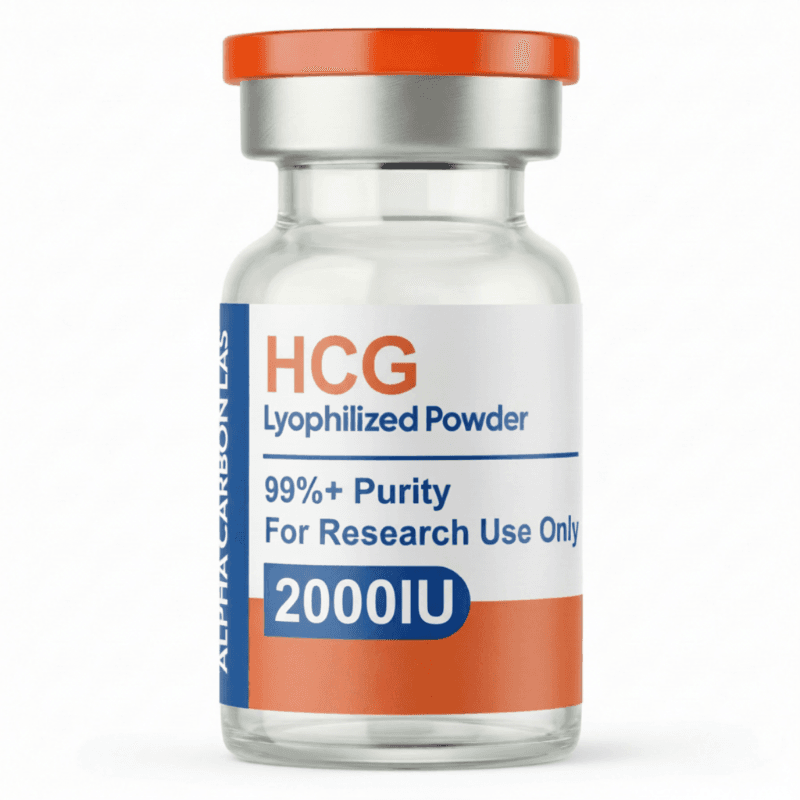
2000IU
This product is for research purposes only. Not for human consumption.
Purity: >98% (HPLC verified)
Formulation: Lyophilized powder
Molecular Formula: N/A (Large glycoprotein)
Molecular Weight: ~36,700 g/mol
CAS Number: 9002-61-3
PubChem CID: N/A
HCG
Overview
Human Chorionic Gonadotropin (HCG) is a glycoprotein hormone consisting of two subunits (an alpha subunit shared with other glycoprotein hormones including LH, FSH, and TSH, and a unique beta subunit) that is naturally produced by the placenta during pregnancy, with production beginning shortly after embryo implantation and rising rapidly during early gestation to support corpus luteum function and maintain progesterone production essential for pregnancy maintenance. HCG's presence in maternal blood and urine forms the basis for pregnancy tests, and its levels follow a characteristic pattern during pregnancy, peaking around 10-12 weeks of gestation before declining to lower sustained levels. Beyond its natural role in pregnancy, HCG has been isolated, purified, and manufactured for clinical and research applications, where it has proven valuable in reproductive medicine, endocrinology, and metabolic research. The hormone shares substantial structural and functional similarity with luteinizing hormone (LH), particularly in the alpha subunit which is identical, and both hormones bind to and activate the same receptor - the luteinizing hormone/choriogonadotropin receptor (LHCGR) - expressed on gonadal cells in both males and females. However, HCG has a significantly longer plasma half-life than LH (approximately 24-36 hours compared to 20-60 minutes for endogenous LH pulses) due to its higher sialic acid content and glycosylation patterns that protect it from renal clearance and enzymatic degradation. This extended duration of action makes HCG clinically useful for situations requiring sustained gonadotropin receptor stimulation. In reproductive medicine, HCG is extensively used to trigger ovulation in assisted reproductive technology protocols, support luteal phase progesterone production, and diagnose and manage pregnancy-related conditions. In males, HCG administration stimulates Leydig cell testosterone production and can support spermatogenesis, making it valuable for treating certain forms of hypogonadism and preventing or reversing testicular atrophy associated with exogenous testosterone therapy or anabolic steroid use. HCG has also garnered attention in weight loss protocols, particularly in the controversial HCG diet popularized in the 1950s and experiencing periodic resurgences, though the scientific evidence supporting metabolic benefits independent of severe caloric restriction remains weak and contested. The hormone's clinical applications are well-established and evidence-based in reproductive medicine, while its use for weight loss and certain other indications remains controversial with limited supporting evidence from rigorous trials.
Mechanism of Action
HCG exerts its biological effects through binding to and activation of the luteinizing hormone/choriogonadotropin receptor (LHCGR), a G-protein coupled receptor (specifically Gs-coupled) that is predominantly expressed on gonadal cells including Leydig cells in the testes, theca cells and corpus luteum cells in the ovaries, and to a lesser extent in other tissues. The shared receptor explains why HCG can substitute for LH in reproductive functions. When HCG binds to LHCGR, it triggers conformational changes that activate Gs proteins, which stimulate adenylyl cyclase to produce cyclic AMP (cAMP) as an intracellular second messenger. Elevated cAMP activates protein kinase A (PKA), which phosphorylates various downstream targets to mediate the hormone's effects. In males, HCG activation of LHCGR on testicular Leydig cells stimulates testosterone biosynthesis through a well-characterized steroidogenic cascade. PKA phosphorylates and activates proteins including the steroidogenic acute regulatory protein (StAR), which facilitates cholesterol transport into mitochondria - the rate-limiting step in steroid hormone synthesis. Within mitochondria, cholesterol is converted to pregnenolone by cytochrome P450 side-chain cleavage enzyme (P450scc), initiating the steroidogenic pathway that ultimately produces testosterone. HCG thus acutely increases testosterone production, with effects detectable within hours and peak levels occurring 24-48 hours after administration. Chronic HCG exposure also upregulates the expression of steroidogenic enzymes, supporting sustained testosterone production. The increased intratesticular testosterone supports spermatogenesis by providing the high local testosterone concentrations needed for normal sperm production in the seminiferous tubules. In females, HCG serves multiple functions depending on the reproductive context. During the natural menstrual cycle, the midcycle LH surge (which HCG can mimic pharmacologically) triggers final oocyte maturation, ovulation (rupture of the mature follicle to release the egg), and luteinization of the ruptured follicle to form the corpus luteum. The corpus luteum produces progesterone, which is essential for preparing and maintaining the endometrium for potential embryo implantation. In early pregnancy, HCG produced by the developing placenta rescues the corpus luteum from its normal regression, maintaining progesterone production until the placenta assumes this function later in pregnancy. In assisted reproductive technology, exogenous HCG administration is used to trigger final oocyte maturation and ovulation in a timed manner, allowing egg retrieval at the optimal moment. The prolonged half-life of HCG compared to natural LH pulses means that a single injection can provide sustained receptor stimulation, whereas maintaining physiological LH signaling would require pulsatile administration. Beyond gonadal effects, LHCGR receptors are expressed at lower levels in other tissues including the endometrium, adipose tissue, and some areas of the brain, where HCG may have additional effects that are less well-characterized. Proposed metabolic effects of HCG (central to its controversial use in weight loss protocols) have included suggestions that it might mobilize adipose tissue, suppress appetite, or redistribute fat, though rigorous mechanistic evidence for these effects independent of severe caloric restriction is lacking.
Research Findings
Research on HCG spans decades and encompasses well-established reproductive medicine applications as well as more controversial metabolic uses. In reproductive medicine and fertility, HCG has been extensively studied and its efficacy is well-documented. In assisted reproductive technology (ART) including in vitro fertilization (IVF), intracytoplasmic sperm injection (ICSI), and ovulation induction protocols, HCG is routinely used to trigger final oocyte maturation and ovulation, with studies confirming that appropriately timed HCG administration results in mature oocytes suitable for fertilization, successful ovulation, and corpus luteum formation. Meta-analyses and systematic reviews have established HCG triggering as standard practice in ART. Research has also explored optimal dosing regimens, with studies comparing different HCG doses and formulations (urinary-derived versus recombinant HCG) showing general equivalence in outcomes though with some potential differences in side effect profiles and cost-effectiveness. Studies in male hypogonadism have demonstrated that HCG can effectively stimulate testosterone production in men with secondary (hypogonadotropic) hypogonadism where the testes are intact but LH stimulation is deficient. Clinical trials show that HCG administration (typically 1000-2500 IU two to three times weekly) can restore testosterone levels to normal ranges while maintaining fertility potential - an advantage over direct testosterone replacement which suppresses endogenous LH and FSH, causing testicular atrophy and infertility. Research in men using exogenous testosterone or anabolic steroids has shown that co-administration of HCG can prevent testicular atrophy and maintain spermatogenesis by providing exogenous gonadotropin stimulation even when endogenous LH and FSH are suppressed. Studies have documented that HCG treatment can help restore testicular size and sperm production during recovery from testosterone or anabolic steroid use, though complete recovery is not guaranteed and depends on duration and dose of prior use. The HCG diet represents one of the most controversial areas of HCG research. Originally popularized by Dr. Albert Simeons in the 1950s based on observations that HCG might mobilize fat stores, the protocol combines daily HCG injections with an extremely restrictive 500-calorie daily diet. Simeons and proponents claimed that HCG allowed substantial weight loss without hunger, muscle loss, or metabolic slowdown. However, rigorous double-blind placebo-controlled trials conducted in the 1970s and subsequently have consistently failed to demonstrate that HCG provides any benefit beyond placebo when both groups follow the same caloric restriction. Studies show equivalent weight loss, body composition changes, and hunger levels between HCG and placebo groups, with all benefits attributable to the severe caloric deficit. Meta-analyses and systematic reviews have concluded there is no scientific evidence supporting HCG as effective for weight loss independent of caloric restriction. Despite this evidence, HCG diet protocols continue to be marketed, representing a disconnect between scientific evidence and commercial promotion. More recent research has explored potential metabolic signaling roles of HCG beyond reproduction, including effects on immune function, angiogenesis, and cellular signaling in various tissues, though these remain areas of ongoing investigation rather than established clinical applications.
Research Applications
- Assisted reproductive technology and IVF research
- Ovulation induction and fertility treatment studies
- Male hypogonadism and testosterone production research
- Testicular function preservation studies
- Spermatogenesis support research
- Recovery from exogenous testosterone or steroid use
- Pregnancy testing and monitoring research
- Ectopic pregnancy and miscarriage diagnosis studies
- Gonadotropin receptor biology research
- Reproductive endocrinology research
Safety Profile
HCG has a well-established safety profile from decades of clinical use in reproductive medicine, where millions of treatment cycles have been administered with comprehensive safety monitoring. When used appropriately under medical supervision for approved indications, HCG demonstrates acceptable safety with predictable side effects. Common adverse effects include injection site reactions (pain, redness, swelling at subcutaneous or intramuscular injection sites), which are typically mild and transient. Mild to moderate headache, fatigue, mood changes, irritability, and restlessness have been reported, likely related to hormonal effects. In females undergoing fertility treatment, the most serious potential adverse event is ovarian hyperstimulation syndrome (OHSS), a potentially life-threatening complication characterized by massive ovarian enlargement, fluid shifts from vascular space into body cavities (ascites, pleural effusions), hemoconcentration, hypercoagulability, and in severe cases, renal failure or thromboembolic events. OHSS risk is increased with high ovarian response to stimulation, polycystic ovary syndrome, and use of HCG for luteal support or triggering. Modern ART protocols have implemented risk reduction strategies including careful monitoring, individualized dosing, and alternative trigger agents (GnRH agonists) in high-risk patients, substantially reducing severe OHSS incidence. In males receiving HCG treatment, potential adverse effects include gynecomastia (breast tissue development) due to aromatization of HCG-stimulated testosterone to estrogen, fluid retention, acne, mood changes, and rarely polycythemia (increased red blood cell production). There are theoretical concerns about prolonged high-dose HCG potentially downregulating LH receptors or causing testicular desensitization, though clinical evidence for this is limited. Prostate monitoring is appropriate in older men as HCG increases testosterone which can stimulate prostate tissue. Concerns about HCG triggering or accelerating hormone-sensitive cancers exist, making it contraindicated in individuals with estrogen- or androgen-dependent tumors. Allergic reactions to HCG preparations are rare but documented, presenting as urticaria, angioedema, or anaphylaxis in sensitized individuals. Use during pregnancy (beyond its natural presence) is generally avoided except for specific indications, and HCG does not suppress milk production so can be used in postpartum women if needed. The primary safety concern in contemporary HCG discourse relates to its off-label use in weight loss protocols, where extremely restrictive diets (500 calories daily) pose significant health risks including nutritional deficiencies, gallstone formation, electrolyte imbalances, cardiac arrhythmias, and eating disorder development, with any perceived benefits coming from the dangerous caloric restriction rather than HCG itself.
Scientific References
Research Use Only
This product is intended for research purposes only and is not for human consumption, therapeutic use, or diagnostic applications. Please ensure compliance with all applicable regulations and institutional guidelines.