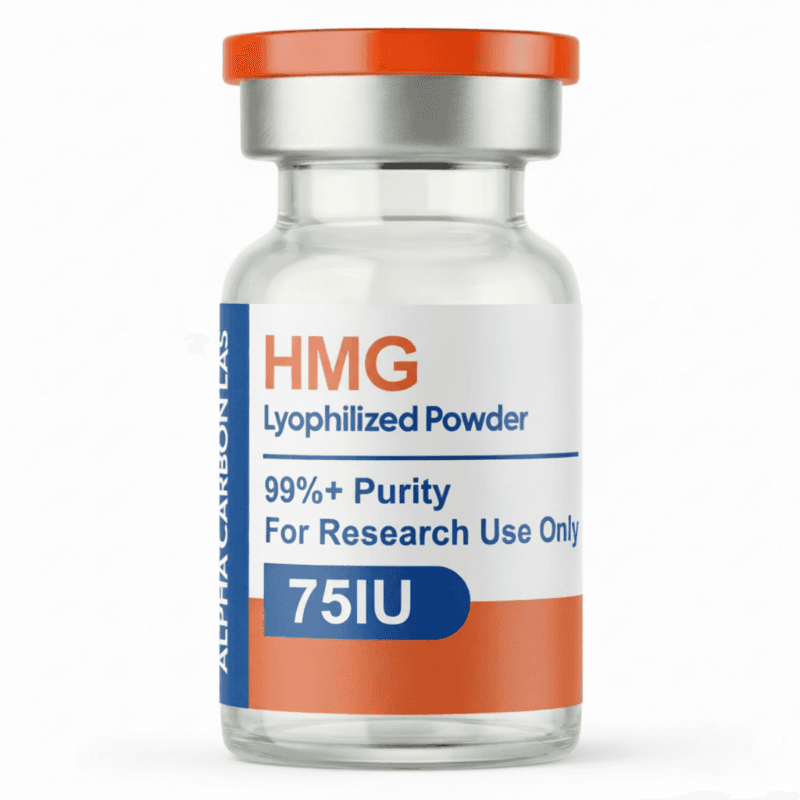
75IU
This product is for research purposes only. Not for human consumption.
Purity: >98% (HPLC verified)
Formulation: Lyophilized powder
Molecular Formula: N/A (Glycoprotein complex)
Molecular Weight: ~30,000-40,000 g/mol
CAS Number: 61489-71-2
PubChem CID: N/A
HMG
Overview
Human Menopausal Gonadotropin (HMG), also known as menotropin, is a medication consisting of purified gonadotropins - specifically follicle-stimulating hormone (FSH) and luteinizing hormone (LH) in approximately equal proportions - that is extracted and purified from the urine of postmenopausal women, who have elevated gonadotropin levels due to loss of negative feedback from ovarian sex steroids. HMG represents one of the earliest successful applications of hormone therapy in reproductive medicine, with use dating back to the 1960s when researchers discovered they could extract and purify these critical reproductive hormones from human urine for therapeutic purposes. The biological rationale for HMG in fertility treatment is straightforward: FSH and LH are essential hormones produced by the anterior pituitary gland that regulate reproductive function in both sexes, and deficiency or dysregulation of these hormones causes infertility. In females, FSH is critical for stimulating ovarian follicle growth, maturation, and estrogen production during the follicular phase of the menstrual cycle, while LH triggers ovulation (the midcycle LH surge) and supports corpus luteum function and progesterone production during the luteal phase. In males, FSH acts on Sertoli cells in the seminiferous tubules to support spermatogenesis, while LH stimulates Leydig cells to produce testosterone, which is essential for sperm production and male sexual function. Women with anovulation (failure to ovulate) due to hypogonadotropic hypogonadism or other causes often have insufficient FSH and LH to drive follicle development and ovulation, while men with hypogonadotropic hypogonadism have deficient gonadotropin stimulation leading to low testosterone and impaired sperm production. HMG provides exogenous FSH and LH to overcome these deficiencies, mimicking the natural gonadotropin stimulation needed for normal reproductive function. In the context of assisted reproductive technology (ART), HMG is used to induce controlled ovarian stimulation - deliberately overstimulating the ovaries to produce multiple mature follicles (instead of the single dominant follicle in a natural cycle) to increase the number of eggs available for retrieval and fertilization in IVF procedures. While recombinant FSH (produced through genetic engineering in cell culture) has largely replaced HMG for many indications due to greater purity, consistency, and manufacturing control, HMG retains a role in fertility treatment particularly for patients who may benefit from the LH activity that is present in HMG but not in pure recombinant FSH products. The inclusion of LH activity in HMG may be advantageous for certain patient populations including older women, poor responders to FSH stimulation, or those with specific hormonal profiles.
Mechanism of Action
HMG exerts its therapeutic effects through the combined actions of its two constituent gonadotropins, FSH and LH, which bind to and activate their respective G-protein coupled receptors on gonadal cells. FSH binds to FSH receptors (FSHR) expressed primarily on granulosa cells surrounding developing ovarian follicles in females and on Sertoli cells in the seminiferous tubules of males. FSH receptor activation triggers Gs-mediated signaling cascades involving adenylyl cyclase activation, cAMP production, protein kinase A (PKA) activation, and downstream effects on gene transcription through CREB and other transcription factors. In ovarian follicles, FSH stimulation promotes granulosa cell proliferation, follicle growth and maturation, aromatase enzyme expression (converting androgens to estrogens), and estradiol production. FSH also upregulates LH receptor expression on granulosa cells, priming them for LH responsiveness later in the follicular phase. Multiple growing follicles are recruited during the early follicular phase, but typically only one (the dominant follicle) continues to develop while others undergo atresia - FSH support is critical for sustaining follicle survival and growth. In HMG-stimulated cycles or controlled ovarian stimulation for IVF, the high exogenous FSH levels prevent atresia of multiple follicles, allowing continued growth and maturation of many follicles simultaneously to produce multiple mature eggs. LH binds to LH/CG receptors (LHCGR) on theca cells in the ovary and Leydig cells in the testes. In females, LH stimulates theca cells to produce androgens (particularly androstenedione), which diffuse to granulosa cells where they are converted to estrogens by aromatase. The midcycle LH surge - which can be mimicked pharmacologically by HCG administration in fertility protocols - triggers final oocyte maturation, ovulation (rupture of the mature follicle to release the egg), and luteinization of the ruptured follicle to form the corpus luteum, which produces progesterone essential for endometrial preparation and early pregnancy support. The LH activity in HMG may be particularly important for women who have low endogenous LH levels or who respond poorly to FSH-only stimulation. In males, LH stimulates Leydig cells to synthesize testosterone through the steroidogenic pathway, providing the high intratesticular testosterone concentrations needed for spermatogenesis support by Sertoli cells. FSH acts on Sertoli cells to support their nurturing and organizational functions for developing sperm cells. The combination of FSH and LH/testosterone is essential for initiating and maintaining spermatogenesis in men with hypogonadotropic hypogonadism who lack endogenous gonadotropin stimulation. HMG treatment protocols typically involve daily subcutaneous or intramuscular injections starting in the early follicular phase (or at any time in amenorrheic women), with dosing individualized based on patient characteristics, ovarian response monitoring through ultrasound and hormone measurements, and treatment goals (ovulation induction versus controlled ovarian hyperstimulation for IVF). Once adequate follicular development is achieved, HCG is typically administered to trigger final maturation and ovulation.
Research Findings
Research on HMG spans over five decades of clinical use and has established it as a foundational therapy in reproductive medicine, with extensive data on efficacy, safety, optimal protocols, and patient selection. Early studies in the 1960s and 1970s demonstrated that HMG could successfully induce ovulation in anovulatory women and support pregnancy achievement, representing a breakthrough in fertility treatment. These pioneering studies established HMG as the first effective pharmacological therapy for ovulation induction, leading to thousands of pregnancies in previously infertile women. Research comparing HMG to clomiphene citrate (an oral selective estrogen receptor modulator that indirectly stimulates gonadotropin release) showed that HMG was more effective for women who failed to ovulate or conceive on clomiphene, particularly those with hypogonadotropic hypogonadism or hypothalamic amenorrhea. Controlled ovarian stimulation research for IVF has extensively studied HMG protocols, dose-response relationships, monitoring strategies, and outcomes. Studies have compared various HMG starting doses (typically 150-300 IU daily) and adjustment strategies based on ovarian response, showing that individualized dosing based on patient age, body mass index, ovarian reserve markers (antral follicle count, anti-Müllerian hormone), and prior response history optimizes outcomes while minimizing risks like ovarian hyperstimulation syndrome (OHSS). Research has also compared step-up protocols (starting low and increasing dose if response is inadequate) versus step-down protocols (starting high and decreasing if response is excessive) with variable results depending on patient population. The development of recombinant FSH (rFSH) in the 1990s prompted extensive comparative research between HMG and rFSH. Multiple randomized controlled trials and meta-analyses have compared efficacy and safety of HMG versus rFSH for ovulation induction and IVF. The overall conclusion from systematic reviews is that pregnancy rates and live birth rates are generally similar between HMG and rFSH, though some analyses suggest slightly higher pregnancy rates with HMG in certain subgroups, possibly related to the LH activity in HMG. Research has also compared highly purified HMG (hp-HMG with reduced protein content) to standard HMG preparations, showing similar efficacy with potentially reduced injection site reactions with purified formulations. LH supplementation research has explored whether adding recombinant LH to rFSH offers benefits compared to using HMG (which contains endogenous LH activity), with studies showing mixed results but suggesting potential benefits for certain patient groups including older women, poor responders, or those with profound LH deficiency. Male infertility research has demonstrated HMG's effectiveness in treating men with hypogonadotropic hypogonadism to restore spermatogenesis and fertility. Studies show that combined FSH/LH (HMG) or FSH plus HCG therapy can successfully initiate and maintain sperm production in men with congenital or acquired gonadotropin deficiency, with treatment typically requiring 6-24 months to achieve maximal sperm counts. Research indicates success rates of 60-90% for achieving sperm production and 40-70% for achieving pregnancy, though outcomes depend on etiology of hypogonadism, duration of deficiency, testicular volume, and other factors. Safety research has characterized HMG's adverse effect profile, with the most significant risk being OHSS, a potentially serious complication of ovarian stimulation characterized by massive ovarian enlargement, ascites, pleural effusions, and in severe cases, thromboembolic events or renal failure. Research has identified risk factors for OHSS (young age, low body weight, polycystic ovary syndrome, high antral follicle count, prior OHSS, rapidly rising estradiol levels, large number of developing follicles) and strategies for prevention including dose adjustment, cycle cancellation, coasting, and using GnRH agonist triggers instead of HCG. Modern protocols have substantially reduced severe OHSS incidence.
Research Applications
- Female infertility and anovulation treatment research
- Controlled ovarian stimulation for IVF and ART studies
- Ovulation induction research and protocols
- Male hypogonadotropic hypogonadism treatment studies
- Spermatogenesis induction and restoration research
- Gonadotropin physiology and receptor biology research
- Reproductive endocrinology and hormone therapy studies
- Infertility etiology and treatment outcome research
- Ovarian reserve and response prediction studies
- OHSS prevention and management research
- Comparative gonadotropin efficacy studies
- Personalized fertility treatment protocol research
Safety Profile
HMG has a well-established safety profile from decades of clinical use in millions of treatment cycles worldwide, with comprehensive understanding of its adverse effect spectrum and risk management strategies. The most significant and concerning adverse event associated with HMG is ovarian hyperstimulation syndrome (OHSS), which occurs in approximately 1-5% of stimulated cycles with variable severity. Mild OHSS causes ovarian enlargement and abdominal discomfort but is self-limited, while moderate OHSS adds significant ascites, nausea, and laboratory abnormalities, and severe OHSS (occurring in <1% of cycles) can be life-threatening with massive fluid shifts, renal failure, thromboembolism, and rarely death if not properly managed. OHSS risk is highest when HCG is used for triggering ovulation in high-responder patients with many growing follicles and high estradiol levels. Modern risk mitigation strategies including careful patient selection, individualized dosing, close monitoring with ultrasound and hormone levels, cycle cancellation when response is excessive, coasting (withholding gonadotropins while allowing follicle maturation), using GnRH agonists instead of HCG for triggering in at-risk patients, and cryopreservation of all embryos with delayed transfer have dramatically reduced severe OHSS incidence. Multiple pregnancy represents another significant concern with HMG treatment, as ovarian stimulation increases the likelihood of multiple follicles ovulating and multiple embryos implanting. Twin, triplet, and higher-order multiple pregnancies carry substantially increased risks of maternal complications (preeclampsia, gestational diabetes, hemorrhage) and fetal/neonatal complications (prematurity, low birth weight, cerebral palsy, mortality) compared to singleton pregnancies. Strategies to reduce multiple pregnancy risk include conservative dosing, careful monitoring with cycle cancellation if too many follicles develop, and in IVF cycles, elective single embryo transfer. Common minor adverse effects include injection site reactions (pain, redness, bruising), which are typically mild and self-limited. Headache, abdominal bloating, breast tenderness, mood changes, and fatigue are reported with variable frequency and attributed to hormonal changes. Allergic reactions to HMG are rare but documented, potentially including urticaria, angioedema, or anaphylaxis in sensitized individuals, though modern purification methods have reduced protein content and allergenicity. Ovarian torsion (twisting of enlarged ovary on its vascular pedicle causing ischemia) is a rare but serious complication requiring emergency surgery. Ectopic pregnancy rates may be slightly elevated in HMG-treated cycles, particularly in women with tubal disease. Long-term safety regarding ovarian cancer risk has been studied extensively, with reassuring data showing no significant increase in ovarian cancer risk associated with fertility drug use after accounting for underlying infertility, which itself confers cancer risk.
Scientific References
Research Use Only
This product is intended for research purposes only and is not for human consumption, therapeutic use, or diagnostic applications. Please ensure compliance with all applicable regulations and institutional guidelines.