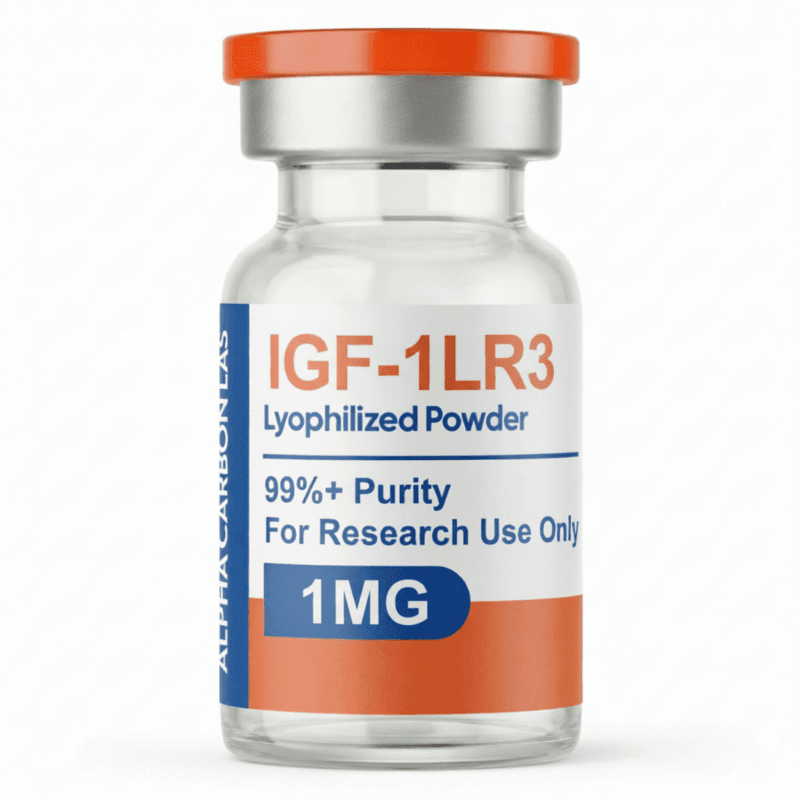
1MG
This product is for research purposes only. Not for human consumption.
Purity: >98% (HPLC verified)
Formulation: Lyophilized powder
Molecular Formula: C400H625N111O115S9
Molecular Weight: 9117.5 g/mol
CAS Number: 946870-92-4
PubChem CID: N/A
IGF-1LR3
Overview
IGF-1 LR3 (Insulin-like Growth Factor-1 Long Arginine 3), also designated as Long R³-IGF-1 or LR³IGF-I, is a highly potent synthetic analog of human insulin-like growth factor-1 (IGF-1) that has been engineered with two specific molecular modifications to dramatically enhance its biological activity, tissue penetration, and pharmacological utility compared to native IGF-1.
Native IGF-1 Background
Native IGF-1 is a 70-amino acid polypeptide hormone that is structurally similar to insulin and serves as the primary mediator of growth hormone's anabolic effects, promoting cellular growth, proliferation, differentiation, and survival across virtually all tissues in the body. IGF-1 is produced predominantly in the liver in response to growth hormone stimulation, but it is also synthesized locally in many tissues where it exerts autocrine and paracrine effects.
However, native IGF-1's therapeutic utility is significantly limited by its tight binding to a family of six IGF-binding proteins (IGFBPs) that sequester over 99% of circulating IGF-1, creating a reservoir that regulates IGF-1 bioavailability, prolongs its half-life, but drastically restricts the amount of free IGF-1 available to bind and activate cell surface IGF-1 receptors.
Structural Modifications
IGF-1 LR3 was specifically designed to overcome this limitation through two strategic structural modifications: First, the peptide contains an N-terminal extension of 13 amino acids (adding glutamic acid residues), bringing the total length to 83 amino acids instead of 70, which sterically interferes with IGFBP binding. Second, a critical substitution of glutamic acid with arginine at position 3 (the "R3" designation) further reduces IGFBP affinity.
These combined modifications reduce IGF-1 LR3's binding affinity for IGFBPs by approximately 100-1000 fold compared to native IGF-1, meaning that a much higher proportion of IGF-1 LR3 exists in the free, bioactive state capable of directly engaging IGF-1 receptors on target cells.
Enhanced Potency
The practical consequence is that IGF-1 LR3 is approximately 2-3 times more potent than equimolar amounts of native IGF-1 in stimulating anabolic processes including protein synthesis, muscle hypertrophy, and cellular proliferation, making it an attractive research tool and experimental therapeutic agent.
The reduced IGFBP binding also enhances tissue penetration and distribution, allowing IGF-1 LR3 to more effectively reach target tissues throughout the body after systemic administration. However, this reduced IGFBP binding comes with a pharmacokinetic trade-off: while native IGF-1 circulates with a half-life of 12-15 hours due to IGFBP stabilization, IGF-1 LR3 has a significantly shorter half-life of approximately 20-30 hours.
IGF-1 LR3 has been extensively studied in research contexts for muscle growth and hypertrophy, muscle wasting conditions, recovery from injury or exercise, body composition optimization, metabolic disorders, wound healing, neuroprotection, and anti-aging applications, though it remains an experimental compound without regulatory approval for human therapeutic use.
Mechanism of Action
IGF-1 LR3 exerts its diverse biological effects primarily through binding to and activation of the insulin-like growth factor-1 receptor (IGF-1R), a receptor tyrosine kinase that is ubiquitously expressed across virtually all cell types and tissues in the body.
Receptor Activation
The IGF-1 receptor shares significant structural homology with the insulin receptor (approximately 60% amino acid sequence similarity). When IGF-1 LR3 binds to the extracellular alpha subunits of IGF-1R, it triggers a conformational change that brings the intracellular beta subunits into close proximity, enabling trans-autophosphorylation of multiple tyrosine residues on the beta subunits' kinase domains.
These phosphorylated tyrosines serve as docking sites for adaptor proteins including insulin receptor substrate-1 (IRS-1), insulin receptor substrate-2 (IRS-2), and Shc, which are recruited to the activated receptor and themselves become phosphorylated, initiating multiple downstream signaling cascades.
PI3K/Akt/mTOR Pathway
The PI3K/Akt/mTOR pathway is particularly crucial for IGF-1 LR3's anabolic and metabolic effects. Phosphorylated IRS proteins recruit and activate PI3-kinase, which generates PIP3 lipid second messengers. PIP3 recruits PDK1 and Akt to the membrane, where PDK1 phosphorylates and activates Akt.
Akt activates mTOR complex 1 (mTORC1), the master regulator of protein synthesis. Active mTORC1 phosphorylates downstream effectors including p70S6K and 4E-BP1, which together increase ribosomal biogenesis, enhance mRNA translation, and drive protein synthesis - the fundamental process underlying muscle hypertrophy and tissue regeneration.
Anti-Catabolic Effects
Akt also promotes anabolism by phosphorylating and inactivating glycogen synthase kinase-3 beta (GSK3β), enhancing glycogen storage. Additionally, Akt phosphorylates and inactivates FoxO family transcription factors, suppressing expression of atrophy-related genes including MuRF1 and MAFbx/atrogin-1.
By simultaneously enhancing protein synthesis through mTOR activation and reducing protein degradation through FoxO inhibition, IGF-1 LR3 shifts the net protein balance dramatically toward anabolism.
MAPK/ERK Pathway
The MAPK/ERK pathway activated by IGF-1 LR3 promotes cellular proliferation and differentiation. Shc recruitment leads to activation of Ras, which initiates a kinase cascade through MEK to ERK1/2. Activated ERK translocates to the nucleus where it phosphorylates transcription factors regulating proliferation and differentiation genes.
This pathway is particularly important for satellite cell activation - muscle-specific stem cells that when activated by IGF-1, re-enter the cell cycle, proliferate, and can differentiate into myoblasts that fuse with existing muscle fibers or create new muscle fibers.
Research Findings
The research literature on IGF-1 LR3 consists primarily of preclinical studies in cell culture and animal models, with very limited controlled human research, reflecting its status as a research chemical rather than a pharmaceutical therapeutic.
Development History
The foundational work on IGF-1 LR3 emerged from pharmaceutical research in the 1990s aimed at developing IGF-1 analogs with improved pharmacological properties. Structural modification studies identified that N-terminal extensions and specific amino acid substitutions could reduce IGFBP binding while preserving or enhancing IGF-1R binding.
Cell Culture Studies
Cell culture studies using myoblasts, fibroblasts, adipocytes, and neuronal cells have demonstrated that IGF-1 LR3 potently stimulates proliferation, differentiation, protein synthesis, glucose uptake, and survival signaling at concentrations 2-3 fold lower than required for equivalent effects with native IGF-1.
Studies specifically in muscle cells have shown that IGF-1 LR3 activates mTOR signaling, increases phosphorylation of p70S6K and 4E-BP1, enhances myotube formation, increases myotube diameter (hypertrophy), and promotes satellite cell activation more effectively than native IGF-1.
Animal Studies
Administration of IGF-1 LR3 to rodents produces dose-dependent increases in body weight and lean body mass, with the weight gain being primarily accounted for by increases in skeletal muscle mass rather than fat accumulation. Studies measuring muscle fiber cross-sectional area have documented hypertrophy of existing muscle fibers.
Research in models of muscle injury or atrophy has shown that IGF-1 LR3 can accelerate recovery of muscle mass and function, reduce fibrosis, and enhance regeneration through enhanced satellite cell activation. Studies in aging animals have shown that IGF-1 LR3 can partially counteract age-related muscle loss (sarcopenia).
Human Research Limitations
Human research specifically examining exogenous IGF-1 LR3 administration is remarkably limited in peer-reviewed scientific literature - searches of PubMed and other databases yield virtually no controlled clinical trials for any indication. This absence reflects IGF-1 LR3's status as a research chemical that has not undergone pharmaceutical development and regulatory approval processes.
Most human data consists of anecdotal reports from bodybuilding communities, with users typically reporting gains in muscle mass and strength, improved recovery, enhanced vascularity, and sometimes hypoglycemic effects. These uncontrolled reports provide limited scientific value but suggest biological activity consistent with animal studies.
Research Applications
- Muscle growth and hypertrophy research
- Muscle recovery and regeneration studies
- Protein synthesis research
- Satellite cell activation studies
- Muscle wasting disorder research
- Exercise physiology studies
- Body composition optimization research
- Sarcopenia and age-related muscle loss studies
- Metabolic disorder and insulin sensitivity research
- Wound healing and tissue repair studies
- Neuroprotection and neurogenesis research
- Bone formation and osteoporosis studies
Safety Profile
IGF-1 LR3 safety data in humans is severely limited due to the absence of controlled clinical trials and systematic safety assessments. This lack of rigorous human safety data represents a significant knowledge gap.
Hypoglycemia Risk
Hypoglycemia (dangerously low blood glucose) is a significant concern because IGF-1 has insulin-like effects on glucose metabolism. It promotes glucose uptake into muscle and adipose tissue and suppresses hepatic glucose production, which can cause blood glucose to drop to dangerous levels particularly in fasted states or with inadequate carbohydrate intake.
Symptoms of hypoglycemia include shakiness, sweating, confusion, loss of consciousness, and in severe cases seizures or death.
Cancer Risk Considerations
Cancer risk is a major theoretical concern given IGF-1's potent mitogenic and anti-apoptotic effects. Elevated IGF-1 levels have been epidemiologically associated with increased risks of several cancers including prostate, breast, and colorectal cancer in observational studies.
Mechanistically, IGF-1 signaling promotes cellular proliferation while inhibiting apoptosis, potentially supporting development and progression of malignancies, particularly in individuals with pre-existing precancerous lesions.
Other Potential Effects
Acromegaly-like effects from chronic IGF-1 elevation could theoretically include jaw enlargement, soft tissue growth, carpal tunnel syndrome, joint pain, and organ enlargement, though these typically require prolonged excessive elevation.
Cardiovascular effects are possible given IGF-1's influences on cardiac function, with potential for cardiac hypertrophy or arrhythmias, though data is limited.
Quality Control Concerns
The lack of pharmaceutical-grade IGF-1 LR3 products and reliance on research chemical suppliers creates significant quality control concerns including purity, identity verification, accurate dosing, sterility, and absence of contaminants. Long-term safety is completely uncharacterized in humans.
Scientific References
Research Use Only
This product is intended for research purposes only and is not for human consumption, therapeutic use, or diagnostic applications. Please ensure compliance with all applicable regulations and institutional guidelines.