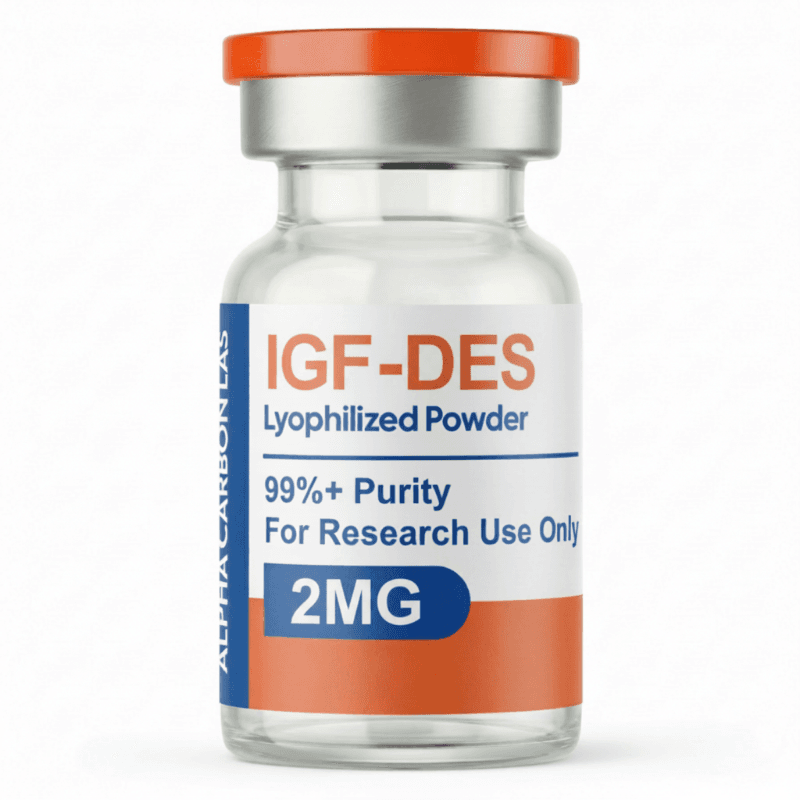
2MG
This product is for research purposes only. Not for human consumption.
Purity: >98% (HPLC verified)
Formulation: Lyophilized powder
Molecular Formula: C319H501N91O96S7
Molecular Weight: 7372 g/mol
CAS Number: 112603-35-7
PubChem CID: N/A
IGF-DES
Overview
IGF-1 DES (Des(1-3)IGF-1), also known as Des(1-3) Insulin-like Growth Factor-1, is a truncated and modified analog of the naturally occurring anabolic hormone IGF-1 that has been engineered to possess dramatically enhanced potency and unique pharmacological properties compared to full-length IGF-1.
Structural Modification
The modification involves deletion of the first three N-terminal amino acids (glycine-proline-glutamate) from the 70-amino acid native IGF-1 sequence, creating a 67-amino acid variant with profound implications for receptor binding, bioavailability, and biological activity. This seemingly simple structural change produces approximately a 10-fold increase in potency compared to full-length IGF-1 in stimulating anabolic processes including protein synthesis, muscle hypertrophy, and cellular proliferation.
IGF Binding Proteins and Bioavailability
The mechanism underlying this enhanced potency relates to IGF-1's complex regulatory system involving IGF binding proteins (IGFBPs), a family of six high-affinity binding proteins (IGFBP-1 through IGFBP-6) that normally sequester the vast majority of circulating IGF-1 and regulate its bioavailability, half-life, and access to cell surface IGF-1 receptors.
In the bloodstream and extracellular fluids, over 99% of endogenous IGF-1 exists bound to IGFBPs, particularly IGFBP-3 in a ternary complex with acid-labile subunit (ALS), which extends IGF-1's half-life but restricts its immediate bioavailability. The N-terminal tripeptide deletion in IGF-1 DES dramatically reduces its binding affinity for all IGFBPs by approximately 100-fold or more, while preserving or even slightly enhancing its affinity for the IGF-1 receptor itself.
Pharmacokinetic Trade-offs
This differential binding creates a molecule that is poorly sequestered by IGFBPs and therefore exists primarily in the free, bioactive form capable of direct receptor engagement. The result is that a much higher proportion of administered IGF-1 DES reaches target tissue receptors compared to an equivalent amount of full-length IGF-1, explaining the approximate 10-fold potency advantage.
However, the reduced IGFBP binding comes with a significant pharmacokinetic trade-off: IGF-1 DES has an extremely short plasma half-life of only 20-30 minutes compared to the 12-15 hour half-life of endogenous IGF-1 in its IGFBP-bound state. This brief duration of action means IGF-1 DES exerts rapid but transient effects, making it particularly suitable for localized administration or situations where acute anabolic stimulation is desired without prolonged systemic exposure.
Mechanism of Action
IGF-1 DES exerts its anabolic and metabolic effects through high-affinity binding to and activation of the IGF-1 receptor (IGF1R), a receptor tyrosine kinase that is widely expressed across virtually all cell types in the body and serves as the primary mediator of IGF-1's growth-promoting, anti-apoptotic, and metabolic actions.
Receptor Structure and Activation
The IGF-1 receptor shares significant structural homology with the insulin receptor, existing as a heterotetrameric complex of two extracellular α-subunits (which contain the ligand binding sites) and two transmembrane β-subunits (which possess intrinsic tyrosine kinase activity in their intracellular domains). When IGF-1 DES binds to the α-subunits of IGF1R, it induces conformational changes that bring the intracellular β-subunit kinase domains into proximity, triggering trans-autophosphorylation of multiple tyrosine residues within the receptor's intracellular domain.
PI3K/Akt/mTOR Signaling
The two primary signaling pathways activated by IGF-1 DES through IGF1R are the PI3K/Akt/mTOR axis and the Ras/Raf/MEK/ERK MAPK cascade, both of which drive anabolic processes, cell survival, proliferation, and metabolic reprogramming. In the PI3K/Akt/mTOR pathway, receptor autophosphorylation recruits and activates phosphoinositide 3-kinase (PI3K), which phosphorylates membrane phospholipids to generate PIP3.
PIP3 recruits and activates Akt (also called protein kinase B), a master regulatory kinase that phosphorylates dozens of downstream substrates to promote anabolism and cell survival. Critical Akt substrates include mTOR, which when activated drives protein synthesis, and FoxO transcription factors, which when phosphorylated by Akt are excluded from the nucleus, preventing their transcriptional activation of atrophy genes.
Muscle-Specific Effects
In skeletal muscle specifically, these signaling events promote muscle fiber hypertrophy (increased muscle cell size), activation and proliferation of satellite cells (muscle stem cells that can fuse with existing fibers or form new fibers), increased myofibrillar protein content and contractile capacity, and overall muscle mass accretion.
The approximately 10-fold enhanced potency of IGF-1 DES compared to full-length IGF-1 means it produces maximal or near-maximal activation of these pathways at much lower concentrations, and because it is not sequestered by IGFBPs, a higher proportion of administered peptide reaches target tissues to drive these anabolic processes.
Research Findings
The research literature on IGF-1 DES is more limited compared to full-length IGF-1 or other well-studied analogs like IGF-1 LR3, reflecting its status as a research chemical and performance enhancement compound rather than a pharmaceutical-track therapeutic.
Foundational Studies
Foundational studies characterizing IGF-1 DES focused on understanding how the N-terminal tripeptide deletion affects binding properties and biological activity. Early work by Francis et al. and colleagues in the 1990s systematically examined various IGF-1 truncations and modifications, establishing that removal of the first three amino acids dramatically reduces IGFBP binding by 100-fold or more while maintaining or slightly increasing IGF-1 receptor affinity.
In Vitro Research
In vitro cell culture studies using various cell types including myoblasts (muscle precursor cells), fibroblasts, and adipocytes demonstrated that IGF-1 DES produces DNA synthesis, cell proliferation, and metabolic responses at approximately one-tenth the concentration required for equivalent effects with full-length IGF-1, confirming the approximately 10-fold potency enhancement.
Animal Studies
Animal studies, primarily in rodents, have explored IGF-1 DES effects on muscle growth and recovery. Research shows that local intramuscular injection of IGF-1 DES produces localized muscle hypertrophy in the injected muscles without systemic effects on non-injected muscles. Studies in aging animals have shown that IGF-1 DES can partially restore age-related declines in muscle mass and strength.
Safety Concerns
Research into potential adverse effects has been limited but raises concerns. In vitro studies show that IGF-1 DES powerfully stimulates proliferation of various cell types, raising theoretical cancer promotion concerns. Hypoglycemia is a known risk with IGF-1 analogs due to their insulin-like metabolic effects, and IGF-1 DES's high potency increases this risk.
Human clinical trial data for IGF-1 DES is essentially nonexistent - no Phase II or III trials have been conducted, making it difficult to establish safety, optimal dosing, or clinical efficacy for any medical condition.
Research Applications
- Localized muscle growth and hypertrophy research
- Muscle injury repair and regeneration studies
- Satellite cell activation and proliferation research
- IGF-1 receptor signaling pathway studies
- Muscle protein synthesis and anabolism research
- Acute metabolic response research
- Muscle hyperplasia (muscle fiber number increase) studies
- Age-related muscle loss and sarcopenia research
- Exercise recovery and adaptation studies
- Body composition optimization research
- Comparative IGF analog pharmacology research
- PI3K/Akt/mTOR pathway activation studies
Safety Profile
The safety profile of IGF-1 DES in humans is poorly characterized due to the absence of rigorous clinical trials and regulatory oversight of this research compound. Available safety information comes primarily from preclinical animal studies, in vitro research, theoretical extrapolations from full-length IGF-1 and insulin biology, and anecdotal reports from non-clinical use in bodybuilding and performance enhancement contexts - none of which provide the comprehensive, controlled data needed to establish true safety parameters. Several significant safety concerns warrant consideration. Hypoglycemia represents a serious acute risk, as IGF-1 DES possesses potent insulin-like metabolic effects including enhanced glucose uptake into muscle and adipose tissue, increased glycogen synthesis, and suppression of hepatic glucose output. The approximately 10-fold potency enhancement over native IGF-1 means that relatively small doses can produce substantial drops in blood glucose, particularly in fasted states, around exercise, or when combined with other glucose-lowering factors. Unlike insulin which has established dosing guidelines and monitoring protocols, IGF-1 DES lacks such standardization, increasing unpredictability of glycemic effects. Symptoms of hypoglycemia can range from mild (tremor, sweating, hunger, confusion) to severe (loss of consciousness, seizures, potentially fatal outcomes if prolonged or untreated), and the short but potent action profile of IGF-1 DES creates periods of high risk. Cancer promotion concerns arise from IGF-1's well-established role in cellular proliferation, survival, and growth. Epidemiological studies have shown associations (though not necessarily causation) between higher circulating IGF-1 levels and increased risk of certain cancers including prostate, breast, and colorectal cancers. While native IGF-1 within physiological ranges appears safe, supraphysiological stimulation of IGF-1 receptor signaling through exogenous administration of potent analogs like IGF-1 DES could theoretically promote growth of existing pre-malignant or malignant cells, accelerate tumor progression, or support metastatic spread by enhancing cell survival and proliferation while inhibiting apoptosis. This risk is particularly concerning with chronic use or in individuals with family histories of cancer or existing malignancies. Organ growth and potential complications from chronic IGF-1 receptor overstimulation represent another concern. While short-term use may cause only transient effects, prolonged supraphysiological IGF-1 receptor activation could potentially cause unwanted tissue growth including cardiac hypertrophy, which at extreme levels could impair cardiac function, and growth of other organs. The lack of long-term safety data means these risks are theoretical but cannot be dismissed. Cardiovascular effects beyond cardiac hypertrophy are poorly characterized for IGF-1 DES specifically, though IGF-1 influences cardiovascular physiology through effects on vascular smooth muscle, endothelial function, blood pressure regulation, and cardiac contractility - chronic perturbation of these processes carries unknown risks. Quality control and contamination issues present practical safety concerns given that IGF-1 DES is primarily available through research chemical suppliers and underground laboratories rather than pharmaceutical manufacturers subject to GMP (good manufacturing practice) regulations. Variability in peptide purity, concentration accuracy, presence of contaminants or degradation products, and microbiological safety creates additional risks beyond the peptide's inherent pharmacological effects. Lack of standardized dosing guidelines, absence of established therapeutic windows, and individual variability in response make it difficult to predict safe and effective doses.
Scientific References
Research Use Only
This product is intended for research purposes only and is not for human consumption, therapeutic use, or diagnostic applications. Please ensure compliance with all applicable regulations and institutional guidelines.