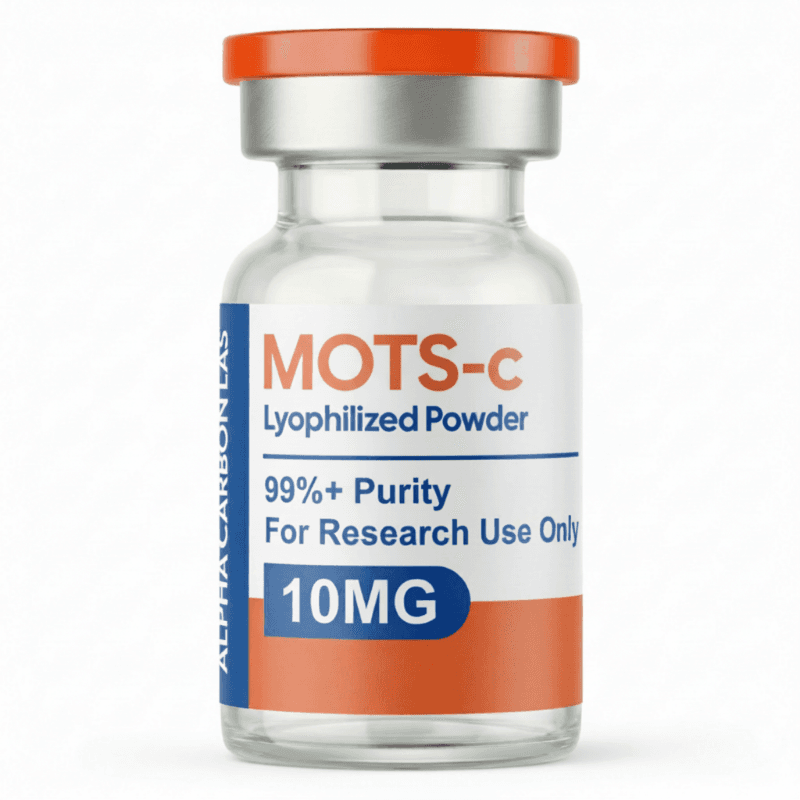
10MG
This product is for research purposes only. Not for human consumption.
Purity: >98% (HPLC verified)
Formulation: Lyophilized powder
Molecular Formula: C121H211N43O22S2
Molecular Weight: 2174.48 g/mol
CAS Number: 1627580-64-6
PubChem CID: N/A
MOTS-c
Overview
MOTS-c (Mitochondrial Open reading frame of the 12S rRNA-c) is a 16-amino acid mitochondrial-derived peptide that represents a revolutionary paradigm shift in our understanding of mitochondrial biology and cellular communication. While mitochondria have long been recognized primarily as the cellular powerhouses responsible for ATP production through oxidative phosphorylation, the discovery of MOTS-c and related mitochondrial-derived peptides has revealed that mitochondria function as sophisticated signaling organelles that encode and secrete bioactive peptides capable of regulating nuclear gene expression, systemic metabolism, and aging processes.
Discovery and Significance
MOTS-c is encoded by a short open reading frame within the mitochondrial 12S ribosomal RNA gene - a region of the mitochondrial genome previously thought to encode only structural RNA components rather than functional peptides. This discovery challenged conventional understanding of the mitochondrial genome and opened an entirely new field investigating the 'mitochondrial peptidome.'
The 16-amino acid sequence of MOTS-c is highly conserved across species, suggesting fundamental biological importance preserved through evolution. Expression and secretion of MOTS-c appear to be regulated by metabolic status, stress conditions, and age, with levels declining during aging in both humans and animal models.
Retrograde Signaling
This age-related decline correlates with deteriorating metabolic function and has positioned MOTS-c as both a biomarker of metabolic aging and a potential therapeutic intervention. MOTS-c functions as a retrograde signaling molecule - meaning it carries information from mitochondria back to the nucleus to coordinate cellular responses to metabolic challenges.
Under conditions of metabolic stress such as glucose restriction, oxidative stress, or exercise, MOTS-c translocates from the cytoplasm into the cell nucleus where it directly regulates the expression of genes involved in metabolism, stress resistance, and cellular adaptation. This mitochondrial-nuclear communication pathway allows the metabolic state of mitochondria to influence whole-cell physiology and systemic metabolism.
Mechanism of Action
MOTS-c exerts its metabolic regulatory effects through multiple interconnected mechanisms centered on its unique ability to serve as a mitochondrial-to-nuclear retrograde signal that coordinates cellular energy metabolism.
Nuclear Translocation
The peptide's primary mechanism involves nuclear translocation during metabolic stress conditions. Under basal conditions, MOTS-c is present in the cytoplasm where it interacts with metabolic enzymes and regulatory proteins. However, when cells experience metabolic challenges including glucose deprivation, oxidative stress, or energetic demands from exercise, MOTS-c accumulates in the nucleus through an active transport process.
Once in the nucleus, MOTS-c binds to specific DNA regulatory regions and interacts with transcription factors to alter gene expression programs. Research has identified that nuclear MOTS-c regulates the expression of genes involved in cellular stress responses, antioxidant defenses, metabolic adaptation, and mitochondrial function.
AMPK Activation
One of MOTS-c's most important metabolic effects is activation of the AMPK (AMP-activated protein kinase) pathway, which serves as a master regulator of cellular energy homeostasis. AMPK activation by MOTS-c occurs through mechanisms that may involve both direct effects and indirect metabolic consequences.
Activated AMPK then triggers a cascade of downstream effects: enhanced glucose uptake in skeletal muscle through GLUT4 translocation, increased fatty acid oxidation, improved mitochondrial biogenesis and function, enhanced insulin sensitivity at cellular and systemic levels, and metabolic reprogramming favoring oxidative metabolism over glycolytic pathways.
Metabolic Effects
In skeletal muscle specifically, MOTS-c has been shown to significantly enhance glucose uptake and utilization even in insulin-resistant states, making it particularly relevant for diabetes research. The peptide also appears to improve mitochondrial quality control through effects on mitophagy and mitochondrial dynamics.
MOTS-c influences cellular metabolism at the enzyme level, with research showing it can inhibit the folate cycle enzyme MTHFD1L, leading to metabolic reprogramming that enhances stress resistance. The peptide also modulates inflammatory responses and oxidative stress, potentially through effects on NF-κB signaling and antioxidant enzyme expression.
Research Findings
The research landscape for MOTS-c has expanded rapidly since its discovery by the Cohen and Lee laboratories at the University of Southern California, with studies demonstrating remarkable metabolic and anti-aging effects across multiple model systems.
Animal Studies
Foundational animal studies have consistently shown that MOTS-c administration produces profound improvements in metabolic health parameters. In mouse models of diet-induced obesity and insulin resistance, MOTS-c treatment prevented weight gain despite continued high-fat feeding, improved glucose tolerance and insulin sensitivity measured by GTT and ITT, reduced fat accumulation particularly visceral adiposity, and improved metabolic flexibility - the ability to switch between fuel sources.
These effects occurred without reducing food intake, indicating metabolic rather than appetite-mediated mechanisms.
Age-Related Decline Studies
Age-related decline studies have shown that endogenous MOTS-c levels decrease with aging in both rodents and humans, correlating with deteriorating metabolic function, and importantly, that exogenous MOTS-c administration to aged animals can partially restore youthful metabolic phenotypes including improved glucose homeostasis, enhanced physical endurance, and better stress resistance.
Exercise Research
Exercise studies revealed particularly intriguing findings: MOTS-c levels increase acutely after exercise in both animals and humans, suggesting it may mediate some exercise benefits; MOTS-c treatment enhanced exercise capacity and endurance even without training; the combination of MOTS-c and exercise produced synergistic effects exceeding either alone; and MOTS-c appeared to mimic some molecular adaptations to exercise training.
Human Translational Research
Human translational research is still limited but growing. Population studies have identified genetic polymorphisms in the mitochondrial 12S rRNA region encoding MOTS-c that are associated with longevity in Japanese cohorts and with variations in insulin sensitivity and metabolic health across populations. These genetic association studies provide evidence that MOTS-c variants influence human healthspan and metabolic phenotypes.
Small human studies have measured circulating MOTS-c levels, finding age-related declines and associations between MOTS-c levels and metabolic health markers. Clinical trials investigating exogenous MOTS-c administration in humans are in early stages, with ongoing studies examining safety, pharmacokinetics, and preliminary efficacy signals for metabolic endpoints.
Research Applications
- Mitochondrial biology and retrograde signaling research
- Metabolic health and insulin sensitivity studies
- Type 2 diabetes and metabolic syndrome research
- Anti-aging and healthspan extension research
- Exercise physiology and performance studies
- Cellular stress response and adaptation research
- Mitochondrial-nuclear communication studies
- AMPK pathway research
- Obesity and weight management studies
- Longevity and aging biomarker research
Safety Profile
MOTS-c has demonstrated excellent safety profiles in preclinical animal studies, with no significant adverse effects reported even at doses substantially exceeding those producing metabolic benefits. As an endogenous peptide naturally produced by human mitochondria, MOTS-c has inherent biocompatibility advantages over synthetic xenobiotic compounds. The peptide's sequence is conserved and present in all humans, suggesting tolerance should be favorable. Early human studies have supported good tolerability, though comprehensive Phase II/III clinical trial data is still emerging. Reported side effects have been minimal and typically limited to mild injection site reactions when administered subcutaneously.
Scientific References
Research Use Only
This product is intended for research purposes only and is not for human consumption, therapeutic use, or diagnostic applications. Please ensure compliance with all applicable regulations and institutional guidelines.