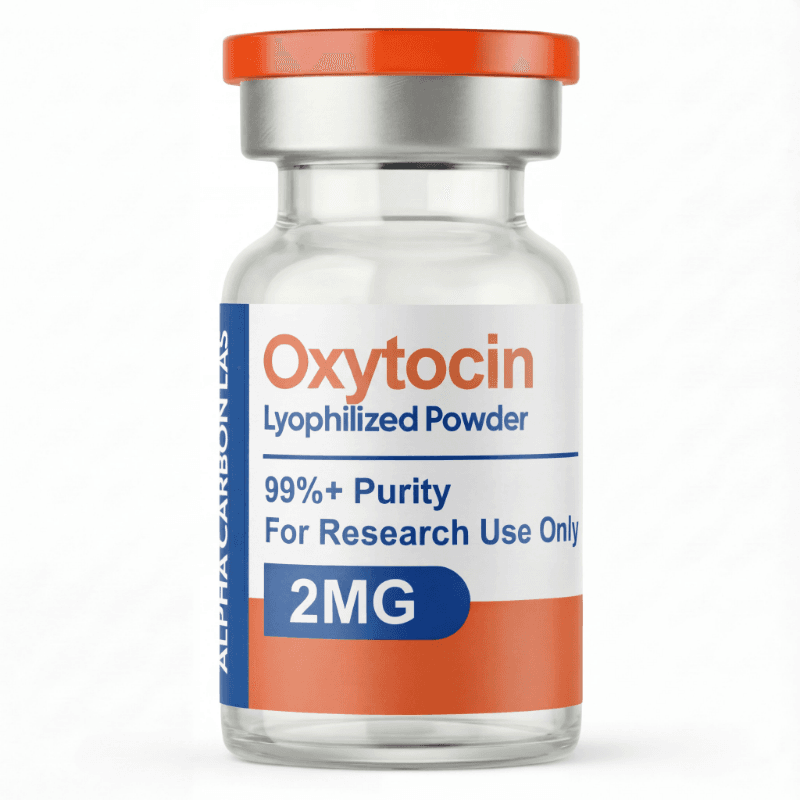
2MG
This product is for research purposes only. Not for human consumption.
Oxytocin
Overview
Oxytocin is a nine-amino acid cyclic neuropeptide hormone (Cys-Tyr-Ile-Gln-Asn-Cys-Pro-Leu-Gly-NH2) with a disulfide bridge between the two cysteine residues that is synthesized primarily in the hypothalamus and released from the posterior pituitary gland. Often referred to as the "love hormone" or "bonding hormone," oxytocin plays fundamental roles in social bonding, maternal behavior, sexual reproduction, childbirth, and lactation, while also influencing numerous physiological processes including cardiovascular function, metabolism, and stress responses.
Discovery and Significance
Oxytocin was the first polypeptide hormone to have its sequence determined and be chemically synthesized, achievements by Vincent du Vigneaud that earned him the 1955 Nobel Prize in Chemistry. The hormone's name derives from Greek meaning "swift birth," reflecting its historically recognized role in stimulating uterine contractions during labor. However, research over the past decades has revealed that oxytocin's functions extend far beyond reproduction, establishing it as a key regulator of complex social behaviors, emotional processing, and stress modulation.
Neurological and Behavioral Effects
Beyond its classical peripheral hormonal effects, oxytocin acts as a neuromodulator within the central nervous system, influencing social cognition, emotional processing, trust, empathy, fear responses, and social memory. Oxytocin neurons project to numerous brain regions including the amygdala, hippocampus, prefrontal cortex, and brainstem nuclei, enabling the hormone to coordinate complex behavioral and physiological responses to social stimuli.
The oxytocin system has become a major focus of research in social neuroscience and psychiatry, with investigations exploring its potential therapeutic applications in conditions characterized by social dysfunction including autism spectrum disorder, social anxiety, schizophrenia, depression, and post-traumatic stress disorder.
Mechanism of Action
Oxytocin exerts its effects primarily through binding to the oxytocin receptor (OXTR), a G-protein coupled receptor that activates multiple intracellular signaling cascades depending on the cellular context and tissue type.
Receptor Signaling
In the classical pathway, oxytocin binding to OXTR activates Gq/11 proteins, leading to phospholipase C activation, generation of inositol trisphosphate (IP3) and diacylglycerol (DAG), calcium release from intracellular stores, and activation of protein kinase C (PKC). This calcium signaling is particularly important in uterine smooth muscle where it drives the contractile responses essential for labor, and in mammary myoepithelial cells where it enables milk ejection.
Central Nervous System Actions
In the central nervous system, oxytocin modulates neural activity through complex mechanisms involving both direct receptor signaling and modulation of other neurotransmitter systems. Oxytocin influences GABAergic inhibition, dopaminergic reward processing, serotonergic mood regulation, and noradrenergic stress responses. The hormone's anxiolytic effects appear mediated partly through enhancement of GABAergic inhibition in the amygdala and modulation of the hypothalamic-pituitary-adrenal (HPA) stress axis.
Social Behavior Modulation
The mechanisms underlying oxytocin's effects on social behavior are multifaceted. Research suggests oxytocin enhances the salience of social stimuli, promotes approach behaviors, reduces social anxiety and fear responses, facilitates social memory formation, and increases trust and prosocial behaviors. These effects involve modulation of neural circuits connecting the amygdala, prefrontal cortex, nucleus accumbens, and other regions involved in emotional processing and social cognition.
Research Findings
Research on oxytocin has expanded dramatically beyond its traditional reproductive and lactation functions to encompass social neuroscience, psychiatry, and behavioral pharmacology, establishing it as one of the most actively studied neuropeptides in contemporary neuroscience.
Social Bonding and Trust
Landmark studies have demonstrated oxytocin's role in human social behavior. Research published in Nature showed that intranasal oxytocin administration increased trust in economic games, with subjects more willing to invest money when trusting strangers. Follow-up studies have explored oxytocin's effects on social memory, face recognition, eye contact, emotional recognition, and empathy, generally supporting an enhancement of social cognitive processing.
Autism Spectrum Disorder Research
Given oxytocin's role in social cognition, considerable research has explored its potential as a therapeutic for autism spectrum disorder (ASD). Studies have examined whether intranasal oxytocin can improve social functioning in individuals with ASD. Some trials have shown improvements in social reciprocity, emotional recognition, and eye gaze, though results have been inconsistent across studies and long-term efficacy remains unclear. Research continues to investigate optimal dosing, individual response variability, and the potential for oxytocin to enhance behavioral interventions.
Anxiety and Stress Research
The anxiolytic properties of oxytocin have been investigated in both animal models and human studies. Research demonstrates that oxytocin attenuates stress responses, reduces amygdala activation to threatening stimuli, and may have therapeutic potential for anxiety disorders and PTSD. Studies in social anxiety disorder have shown that intranasal oxytocin can reduce anxiety symptoms and improve social interaction quality.
Cardiovascular and Metabolic Effects
Beyond behavioral effects, research has revealed oxytocin's involvement in cardiovascular regulation, with effects on heart rate, blood pressure, and cardiac healing. Studies have also explored oxytocin's metabolic effects, including influences on food intake, energy metabolism, and potential applications in obesity research.
Research Applications
- Social cognition and bonding research
- Autism spectrum disorder studies
- Anxiety and stress response research
- Trust and prosocial behavior studies
- Maternal behavior and attachment research
- Reproductive physiology studies
- Cardiovascular function research
- Post-traumatic stress disorder studies
- Schizophrenia social cognition research
- Empathy and emotional recognition studies
Safety Profile
Oxytocin has been used clinically for decades (as Pitocin/Syntocinon) for labor induction and postpartum hemorrhage with well-established safety profiles in these contexts. Intranasal oxytocin administration in research settings has generally shown good tolerability with minimal side effects. Reported side effects are typically mild and include nasal irritation, headache, and occasional dizziness. However, oxytocin's complex effects on social behavior raise considerations about context-dependent effects - the hormone may enhance in-group favoritism while increasing out-group derogation in some contexts. Long-term effects of repeated oxytocin administration remain understudied. The hormone should not be used during pregnancy except under medical supervision due to uterotonic effects. Individual variability in response to oxytocin, influenced by factors including baseline anxiety, attachment style, early life experiences, and genetic variations in the oxytocin receptor, may affect both efficacy and optimal dosing in research applications.
Scientific References
Research Use Only
This product is intended for research purposes only and is not for human consumption, therapeutic use, or diagnostic applications. Please ensure compliance with all applicable regulations and institutional guidelines.