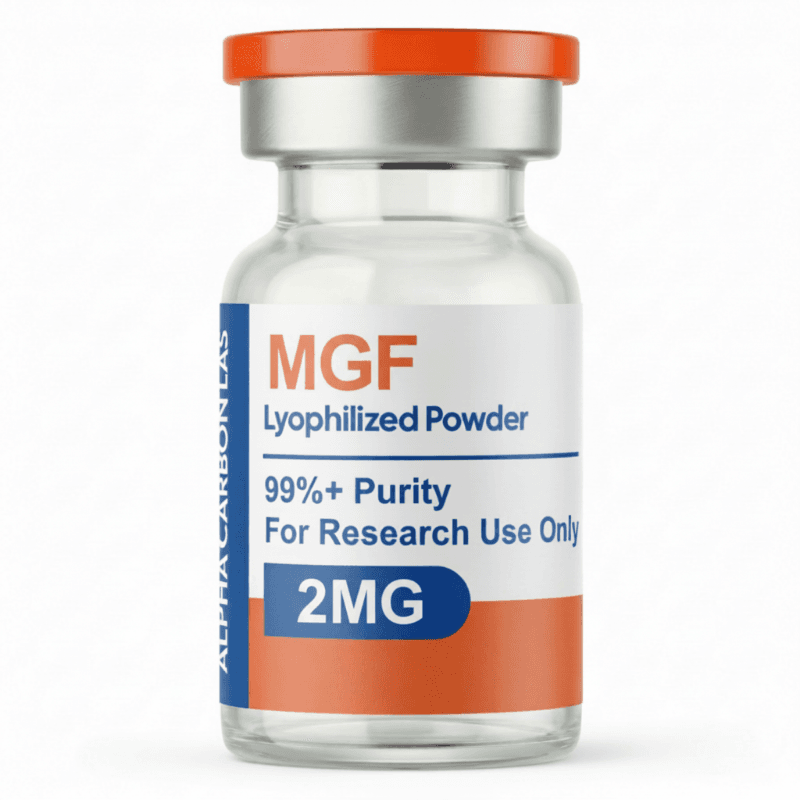
2MG
This product is for research purposes only. Not for human consumption.
Purity: >98% (HPLC verified)
Formulation: Lyophilized powder (Pegylated)
Molecular Formula: C37H51N9O10S (+ PEG)
Molecular Weight: ~1000-2000 g/mol
CAS Number: N/A
PubChem CID: N/A
PEG MGF
Overview
PEG-MGF (Pegylated Mechano Growth Factor) represents a bioengineered modification of the naturally occurring mechano growth factor (MGF), a splice variant of IGF-1 that is produced locally in muscle tissue in response to mechanical stress, exercise, or injury.
PEGylation Technology
While native MGF has a remarkably short plasma half-life of only 5-7 minutes due to rapid proteolytic degradation and renal clearance, PEG-MGF has been chemically modified through covalent attachment of polyethylene glycol (PEG) polymers to the peptide backbone - a process called PEGylation that dramatically extends the biological half-life, improves stability, reduces immunogenicity, and allows for systemic rather than purely local effects.
PEGylation is a well-established pharmaceutical strategy used in numerous FDA-approved biologics including pegfilgrastim (Neulasta), peginterferon alfa (PegIntron, Pegasys), and pegaspargase (Oncaspar), where attachment of inert, biocompatible PEG chains to proteins or peptides creates a larger hydrodynamic radius that slows renal filtration, shields the molecule from proteolytic enzymes, and reduces immune recognition and clearance.
Pharmacokinetic Advantages
In the case of PEG-MGF, PEGylation extends the half-life to hours or potentially days (depending on the size and number of PEG chains attached), transforming a locally-acting muscle repair signal into a systemically-available anabolic agent that can reach multiple muscle groups and potentially other tissues throughout the body following subcutaneous or intramuscular injection.
The theoretical advantage of PEG-MGF over native MGF is the ability to provide sustained MGF receptor activation without requiring local injection into each muscle group of interest, and the extended duration means less frequent dosing is required.
Research Status
The peptide retains MGF's mechanism of action - binding to IGF-1 receptors with particular effectiveness at activating satellite cells (muscle stem cells) and promoting their proliferation, differentiation, and fusion with existing muscle fibers to support muscle hypertrophy and repair.
However, it's crucial to note that PEG-MGF exists primarily as a research chemical and experimental compound rather than a pharmaceutical-grade therapeutic, with virtually no published peer-reviewed research specifically examining PEG-MGF's pharmacokinetics, pharmacodynamics, efficacy, or safety in controlled studies.
Mechanism of Action
PEG-MGF is intended to retain the biological mechanism of native MGF while benefiting from the pharmacokinetic advantages conferred by PEGylation.
Native MGF Biology
Native MGF is a 49-52 amino acid splice variant of IGF-1 (specifically the IGF-1Ec isoform) that differs from systemic liver-derived IGF-1 in its C-terminal E domain sequence, created through alternative splicing of the IGF-1 gene in response to mechanical signals in muscle tissue. This unique C-terminal sequence is thought to provide specific biological properties that make MGF particularly effective at stimulating satellite cell activation and muscle regeneration at local injury or stress sites.
Receptor Signaling
MGF binds to IGF-1 receptors (IGF1R), which are receptor tyrosine kinases expressed on muscle fibers, satellite cells, and many other cell types. Receptor binding triggers autophosphorylation of the receptor's intracellular kinase domains and recruitment of adaptor proteins including IRS-1 and Shc, initiating the PI3K/Akt/mTOR and MAPK signaling cascades that drive protein synthesis, cell survival, proliferation, and hypertrophy.
In satellite cells specifically, MGF appears to be particularly potent at stimulating their activation from quiescence, promoting their entry into the cell cycle, supporting their proliferation to expand the satellite cell pool, and facilitating their differentiation and fusion with damaged or growing muscle fibers - processes essential for muscle repair after injury and for muscle hypertrophy in response to resistance training.
Pharmacological Profile
Native MGF acts predominantly in a paracrine/autocrine manner, being produced locally in muscle tissue and acting on nearby cells within the same muscle, with minimal systemic distribution due to its extremely short half-life. PEGylation fundamentally alters this pharmacology by protecting the peptide from degradation and extending circulation time, theoretically allowing PEG-MGF to reach muscles throughout the body after systemic administration.
The PEG modification may also reduce binding to IGF binding proteins (IGFBPs) which normally sequester IGF family peptides, potentially increasing free peptide availability for receptor binding. However, PEGylation could potentially affect receptor binding affinity, cellular uptake, or signaling potency in ways that haven't been thoroughly characterized for this specific molecule.
Research Findings
The research foundation for PEG-MGF is remarkably limited compared to most peptides discussed in this database, reflecting its status as a research chemical derivative rather than a pharmaceutical compound that has undergone systematic development and clinical testing.
Limited Direct Evidence
Peer-reviewed published research specifically examining PEG-MGF is essentially absent - searches of PubMed and other scientific databases yield no controlled studies, clinical trials, or even detailed preclinical characterization of PEG-MGF formulations. The available literature focuses on native MGF rather than its PEGylated derivative, with studies of native MGF providing the theoretical basis for PEG-MGF's purported effects but not directly validating the PEGylated version's efficacy or safety.
Native MGF Research
Research on native MGF has demonstrated that this splice variant is upregulated in muscle tissue following mechanical stress from resistance exercise, eccentric contractions, or muscle damage, with levels peaking hours after the stimulus and declining over subsequent days. Studies using Northern blot, RT-PCR, and in situ hybridization techniques have mapped the temporal and spatial expression patterns of MGF in muscle following mechanical stimuli.
Cell culture studies have shown native MGF can activate satellite cells more effectively than systemic IGF-1 when applied locally to cultured muscle cells or isolated satellite cells, promoting their proliferation measured by DNA synthesis assays and bromodeoxyuridine incorporation, supporting their differentiation assessed by myogenic marker expression including MyoD and myogenin, and enhancing their fusion with existing myotubes or with each other to form new multinucleated muscle fibers.
Animal Studies
Animal studies involving local injection of native MGF peptide or plasmid DNA encoding MGF directly into rodent muscles have shown enhanced muscle growth measured by increased muscle weight and fiber cross-sectional area, accelerated recovery from experimentally-induced muscle injury with faster restoration of muscle mass and force production, reduced fibrosis and improved muscle quality following severe injuries, and increased satellite cell numbers demonstrated through immunohistochemical detection of satellite cell markers including Pax7.
Unanswered Questions
The absence of published PEG-MGF research means critical questions remain unanswered: What are the actual pharmacokinetic parameters of various PEG-MGF formulations? Does PEGylation preserve the full biological activity of MGF at IGF-1 receptors? Can systemically administered PEG-MGF achieve therapeutically relevant concentrations in muscle tissue? The lack of answers to these fundamental questions means that use of PEG-MGF is essentially experimental.
Research Applications
- Systemic IGF/MGF delivery research
- PEGylation strategy and peptide modification studies
- Muscle growth and hypertrophy research
- Satellite cell activation and muscle regeneration studies
- Athletic performance and recovery research
- Muscle wasting disorder studies
- Body composition optimization research
- Comparative IGF analog pharmacology
- Pharmacokinetic enhancement research
- Prolonged-release peptide formulation studies
Safety Profile
The safety profile of PEG-MGF in humans is essentially uncharacterized due to the complete absence of controlled clinical trials, systematic safety assessments, or even published case reports in medical literature. Available safety information is limited to theoretical considerations based on native MGF biology, general PEGylation toxicology from other PEGylated biologics, and anecdotal reports from bodybuilding and athletic communities where PEG-MGF has been used experimentally without medical supervision or systematic monitoring. PEGylation itself is generally considered safe and is employed in numerous FDA-approved pharmaceutical biologics where it has demonstrated excellent biocompatibility, with polyethylene glycol being non-toxic, non-immunogenic, and well-tolerated at the molecular weights typically used in pharmaceutical applications (ranging from 5 kDa to 40 kDa PEG chains). PEG is eventually eliminated through renal excretion without accumulation or metabolism to toxic byproducts. However, the safety of PEGylation technology in approved drugs does not automatically translate to safety of PEG-MGF specifically, given that the biological activity of the attached peptide, the specific PEGylation chemistry and sites of attachment, and the resulting pharmacological properties all influence the overall safety profile. Theoretical safety concerns based on MGF's mechanism of action include potential effects on glucose metabolism given that IGF-1 family peptides have insulin-like effects that could cause hypoglycemia, particularly in fasted states or when combined with other glucose-lowering agents, though the magnitude of this risk with PEG-MGF is unknown. Cancer risk is a significant theoretical concern because IGF-1 signaling promotes cellular proliferation and inhibits apoptosis, effects that could theoretically support development or progression of malignancies particularly with chronic elevation of IGF-1 receptor activity - epidemiological studies have associated elevated IGF-1 levels with increased cancer risk for several malignancy types, though whether short-term PEG-MGF use poses meaningful cancer risk is unclear and likely depends on duration, dose, and individual cancer susceptibility factors. Excessive or inappropriate muscle growth could theoretically occur with dysregulated satellite cell activation, though this seems less likely with transient use. Cardiovascular effects are possible given IGF-1's influences on cardiac tissue, though specific risks are uncharacterized. Injection site reactions including pain, swelling, or infection risk apply to any injectable compound, with additional concerns when peptides are obtained from unregulated research chemical suppliers rather than pharmaceutical manufacturers. The lack of pharmaceutical-grade PEG-MGF products and reliance on research chemical suppliers creates perhaps the most significant safety concern - quality control issues including uncertain purity (presence of contaminants, degradation products, or related substances), uncertain identity (product may not be PEG-MGF as labeled, or may be native MGF marketed as PEG-MGF), inaccurate concentration or dosing information, variability in PEGylation parameters (PEG molecular weight, degree of PEGylation, attachment sites) between different supplier batches or products, lack of sterility assurance creating infection risks, and presence of endotoxins or other harmful contaminants from manufacturing processes. These quality concerns represent uncontrolled variables that substantially increase risk beyond the inherent pharmacological risks of the compound itself. Long-term safety is completely uncharacterized - chronic use effects, potential for tolerance or desensitization to effects, impacts on endogenous IGF-1/MGF/GH regulation and feedback systems, and any delayed or cumulative toxicities are unknown. Use in specific populations including adolescents (where effects on normal growth and development are concerning), individuals with existing cancers or precancerous lesions, those with diabetes or metabolic disorders, those with cardiovascular disease, and those with kidney or liver impairment has not been studied. The absence of regulatory oversight, lack of medical supervision in typical use contexts, absence of established clinical dosing guidelines, and lack of safety monitoring protocols means that individuals using PEG-MGF are conducting entirely uncontrolled self-experimentation with unknown and potentially serious risks.
Scientific References
Research Use Only
This product is intended for research purposes only and is not for human consumption, therapeutic use, or diagnostic applications. Please ensure compliance with all applicable regulations and institutional guidelines.