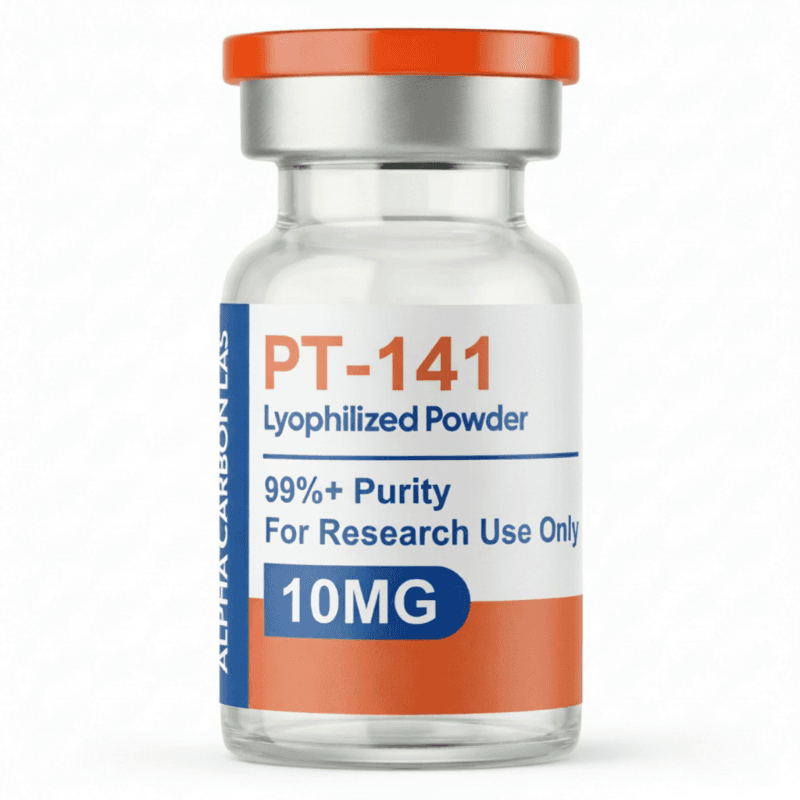
10MG
This product is for research purposes only. Not for human consumption.
Purity: >98% (HPLC verified)
Formulation: Lyophilized powder
Molecular Formula: C50H68N14O10
Molecular Weight: 1025.2 g/mol
CAS Number: 189691-06-3
PubChem CID: 9941379
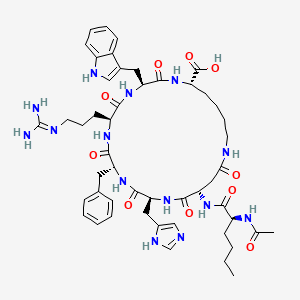
PT-141
Overview
PT-141 (Bremelanotide) is a synthetic cyclic heptapeptide derived from Melanotan II that acts as a melanocortin receptor agonist with a unique mechanism of action among sexual dysfunction treatments. Unlike phosphodiesterase-5 (PDE5) inhibitors like Viagra or Cialis that work through peripheral vascular mechanisms, PT-141 works through central nervous system pathways to enhance sexual desire and arousal.
FDA Approval and Unique Position
This fundamental mechanistic distinction positions PT-141 as the first and currently only FDA-approved treatment specifically targeting hypoactive sexual desire disorder (HSDD) in premenopausal women. HSDD is a common condition affecting an estimated 10% of adult women, characterized by persistent or recurrent deficiency or absence of sexual fantasies and desire for sexual activity that causes marked distress or interpersonal difficulty.
Development from Melanotan II
The development of PT-141 emerged from research on Melanotan II (MT-2), a peptide originally synthesized for photoprotection and skin tanning through melanocortin-1 receptor (MC1R) activation. Unexpectedly, MT-2 produced powerful sexual arousal and erectile effects in early human trials - effects so pronounced that they redirected research focus toward sexual dysfunction applications.
PT-141 was specifically engineered to retain the sexual enhancement properties mediated by melanocortin-3 and melanocortin-4 receptor (MC3R and MC4R) activation in the brain while reducing the unwanted MC1R-mediated skin tanning effects of MT-2.
Central Mechanism of Action
The peptide binds to melanocortin receptors in hypothalamic and limbic brain regions involved in sexual motivation, desire, and arousal. This central mechanism means PT-141 can produce sexual enhancement even in individuals with vascular dysfunction or other peripheral limitations that render PDE5 inhibitors ineffective or contraindicated.
The peptide's effects encompass:
- Psychological components: Increased sexual desire, fantasies, and motivation
- Physiological components: Enhanced genital arousal and lubrication in women, erectile responses in men
Clinical Usage
PT-141 gained FDA approval in June 2019 as Vyleesi for treatment of acquired, generalized HSDD in premenopausal women. The approved formulation is administered as a subcutaneous autoinjector delivering 1.75 mg, taken as needed approximately 45 minutes before anticipated sexual activity, with recommendations not to exceed one dose in 24 hours or eight doses per month.
Beyond its approved indication, PT-141 has been investigated and used off-label for male erectile dysfunction, particularly in men who don't respond to PDE5 inhibitors or have contraindications to their use.
Mechanism of Action
PT-141 exerts its pro-sexual effects primarily through agonist activity at melanocortin receptors, particularly MC3R and MC4R, which are G-protein coupled receptors expressed in key brain regions regulating sexual function, motivation, and reward.
Melanocortin Receptor System
While melanocortin receptors were historically studied for their roles in pigmentation (MC1R), adrenal function (MC2R), energy homeostasis and appetite (MC3R and MC4R), and exocrine function (MC5R), research in the 1990s and 2000s revealed that MC3R and MC4R in specific brain nuclei are critically involved in sexual behavior and arousal.
PT-141 binds to these receptors with high affinity, triggering activation of Gs-coupled signaling pathways that increase intracellular cyclic AMP (cAMP), activate protein kinase A (PKA), and modulate neuronal excitability and neurotransmitter release in circuits controlling sexual function.
Key Brain Regions
The key anatomical sites of PT-141's action include:
- Medial preoptic area (MPOA) of the hypothalamus: A critical region for integrating sexual motivation and coordinating sexual behavior
- Paraventricular nucleus (PVN): Influences both descending autonomic pathways controlling genital arousal responses and ascending pathways to limbic regions
- Limbic system structures: Including amygdala and nucleus accumbens, which modulate dopaminergic and oxytocinergic systems
Central vs. Peripheral Effects
PT-141's effects are primarily central (brain-mediated) rather than peripheral (genital-vascular). This central mechanism contrasts fundamentally with PDE5 inhibitors, which work by inhibiting phosphodiesterase-5 enzyme in genital smooth muscle - a purely peripheral vascular mechanism that doesn't directly address desire or motivation.
PT-141's central action means it can enhance multiple dimensions of sexual function:
- Increases sexual desire and motivation - the psychological wanting of sexual activity
- Enhances subjective arousal and pleasure through effects on brain reward circuits
- Facilitates physiological genital arousal through central activation of autonomic pathways
Pharmacokinetics
The peptide's effects develop within 30-45 minutes of subcutaneous administration, corresponding to the time required to cross the blood-brain barrier and activate central melanocortin receptors. Peak effects occur approximately 2-3 hours post-administration with duration of action extending 6-12 hours. The elimination half-life is approximately 2-3 hours, though pharmacodynamic effects outlast plasma levels due to persistent receptor activation.
Research Findings
The clinical development program for PT-141 represents one of the most extensive research efforts in the sexual medicine field, culminating in FDA approval for HSDD in premenopausal women.
Preclinical Research
The foundational preclinical research emerged from observations during Melanotan II trials when pronounced sexual arousal effects were noted as unexpected adverse events. Animal studies in rats and other species demonstrated that melanocortin agonists could enhance sexual behavior, increase mounting frequency, and facilitate sexual responses through central nervous system mechanisms.
Early human proof-of-concept studies showed that healthy men and women reported increased sexual arousal and desire following administration, with men experiencing erections even in non-sexual contexts.
Phase III Clinical Trials
The pivotal Phase III clinical trial program for HSDD in premenopausal women enrolled over 1,200 participants across two identical randomized, double-blind, placebo-controlled trials. Women with diagnosed HSDD received either PT-141 1.75 mg or placebo administered subcutaneously as needed before anticipated sexual activity over 24 weeks.
Key findings published in JAMA Internal Medicine:
- Statistically significant and clinically meaningful improvements in satisfying sexual events
- Approximately 0.5-1.0 additional satisfying sexual events per month compared to placebo
- Significant improvements in desire scores on the Female Sexual Function Index
- Significant reduction in distress associated with low sexual desire
- Effects maintained throughout 24 weeks without tolerance development
Male Erectile Dysfunction Research
Research in male erectile dysfunction has shown promising results, particularly in men with psychogenic ED or those who fail to respond to PDE5 inhibitors. PT-141 may be effective in men with neurogenic erectile dysfunction or diabetes-related ED where vascular approaches have limited efficacy.
Comparative studies examining PT-141 versus sildenafil showed different efficacy profiles - sildenafil produced more reliable erectile responses but PT-141 showed advantages in enhancing desire and spontaneity.
Neuroimaging Studies
Mechanistic neuroimaging studies using functional MRI have examined PT-141's effects on brain activation patterns during sexual stimuli presentation, showing that the peptide modulates activity in limbic and paralimbic regions involved in sexual arousal and motivation, providing objective evidence for its central mechanism of action.
Research Applications
- Sexual desire disorder research
- Erectile dysfunction studies
- Central nervous system sexual response research
- Melanocortin receptor research
- Female sexual dysfunction studies
- Psychological arousal research
- Hypoactive sexual desire disorder treatment
- Sexual motivation and reward pathway studies
- Brain imaging of sexual response research
Safety Profile
PT-141 has undergone extensive safety evaluation through multiple Phase I, II, and III clinical trials involving thousands of participants, with an overall safety profile that is manageable and well-characterized.
Common Side Effects
The most common adverse events reported in clinical trials include:
- Nausea: Reported by approximately 40% of participants, typically mild to moderate, related to melanocortin receptor activation in brainstem areas
- Flushing: Facial redness occurring in about 20% of users
- Injection site reactions: Pain, erythema, or bruising common with subcutaneous administration
- Headache: Affecting approximately 11% of participants
These events are generally transient, occurring soon after administration and resolving within hours without intervention. Nausea typically diminishes with repeated use as tolerance develops.
Cardiovascular Considerations
PT-141 can cause transient increases in blood pressure and heart rate, with mean increases of 3-10 mmHg systolic and 2-5 mmHg diastolic pressure observed in clinical trials. These effects peak approximately 4 hours post-administration and return to baseline within 12 hours.
Due to these cardiovascular effects, PT-141 is contraindicated in patients with uncontrolled hypertension or known cardiovascular disease. Blood pressure should be monitored, particularly in patients with cardiovascular risk factors.
Other Considerations
- Hyperpigmentation: Minimal compared to Melanotan II due to reduced MC1R affinity and intermittent dosing
- Long-term safety: Data spanning up to one year has not revealed unexpected adverse events or cumulative toxicity
- Pregnancy: Category not established; use not recommended during pregnancy and breastfeeding
- Drug interactions: No significant interactions identified, but caution advised with blood pressure medications
Scientific References
Research Use Only
This product is intended for research purposes only and is not for human consumption, therapeutic use, or diagnostic applications. Please ensure compliance with all applicable regulations and institutional guidelines.