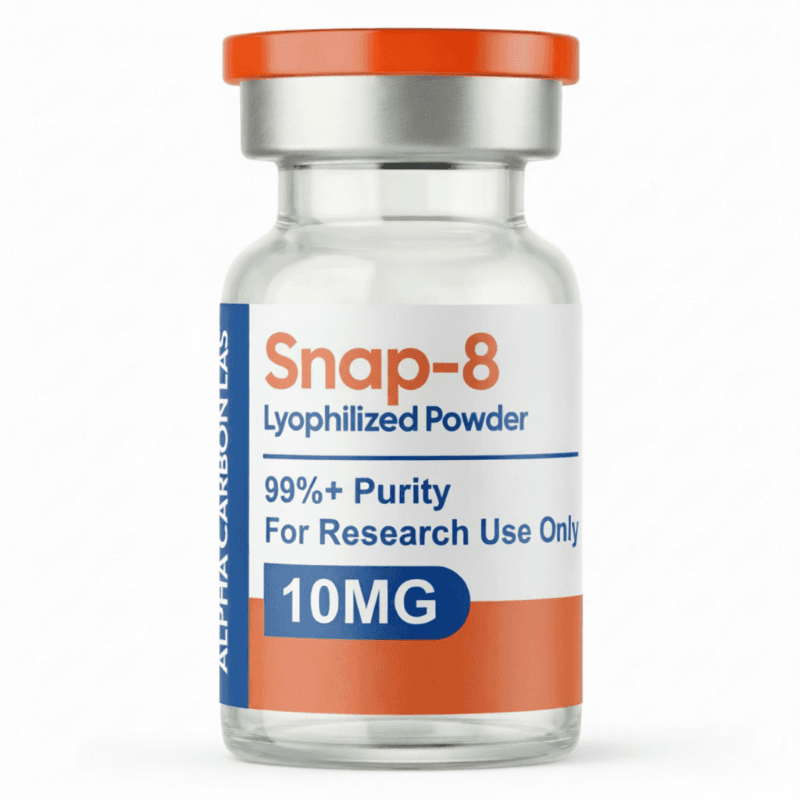
10MG
This product is for research purposes only. Not for human consumption.
Purity: >98% (HPLC verified)
Formulation: Lyophilized powder
Molecular Formula: C41H70N16O16S
Molecular Weight: 1075.16 g/mol
CAS Number: 868844-74-0
PubChem CID: N/A
Snap-8
Overview
Snap-8 (Acetyl Octapeptide-3, with the sequence Ac-Glu-Glu-Met-Gln-Arg-Arg-Ala-Asp-NH2) is a synthetic octapeptide that represents an elongated and enhanced version of the well-known cosmetic peptide Argireline (Acetyl Hexapeptide-8), developed by the Spanish company Lipotec (now part of Lubrizol) as a topically applied alternative to Botulinum toxin injections for reducing the appearance of facial expression lines and wrinkles.
Peptide Design and Rationale
The peptide was rationally designed based on understanding of the SNARE (soluble N-ethylmaleimide-sensitive factor attachment protein receptor) complex, a protein assembly that is essential for vesicle fusion and neurotransmitter release at the neuromuscular junction. By adding two amino acids to the Argireline sequence, Snap-8 was engineered to have enhanced potency, better skin penetration properties, and improved stability compared to its predecessor, while maintaining the same fundamental mechanism of action - modulating neurotransmitter release to reduce muscle contraction intensity.
Cosmetic Applications
The cosmetic rationale is straightforward: many facial wrinkles, particularly on the forehead, around the eyes (crow's feet), and between the eyebrows (glabellar lines), are expression lines caused by repeated muscle contractions during facial expressions. Botulinum toxin injections effectively smooth these wrinkles by paralyzing the underlying facial muscles, preventing contraction, but this requires injections, carries some risks, and produces complete muscle paralysis that can result in unnatural appearance or loss of expressiveness.
Snap-8 aims to provide a milder, non-invasive, topical alternative that can reduce muscle contraction intensity without complete paralysis, allowing natural facial expressions while softening the appearance of expression lines. The peptide is incorporated into anti-aging serums, creams, and cosmetic formulations and is marketed as providing "Botox-like" effects without injections, though it's important to note that topical peptides like Snap-8 produce much milder effects than Botulinum toxin injections and work through different mechanisms.
Snap-8 has become a popular ingredient in the cosmeceutical industry - products positioned between cosmetics and pharmaceuticals - where it is valued for its scientific rationale, safety profile, and moderate efficacy in clinical studies.
Mechanism of Action
Snap-8 exerts its wrinkle-reducing effects through a mechanism that targets the SNARE complex, a highly conserved protein assembly that is essential for the fusion of synaptic vesicles with the presynaptic membrane and the subsequent release of neurotransmitters at the neuromuscular junction.
SNARE Complex Function
The SNARE complex is formed by the interaction of three proteins: SNAP-25 (synaptosome-associated protein of 25 kDa) and syntaxin-1 on the presynaptic membrane, and VAMP (vesicle-associated membrane protein, also called synaptobrevin) on the synaptic vesicle membrane. When a nerve impulse reaches the motor neuron terminal, calcium influx triggers SNARE complex formation, bringing the vesicle and plasma membranes into close proximity and causing them to fuse, releasing acetylcholine into the synaptic cleft. Acetylcholine then binds to nicotinic receptors on the muscle fiber, causing depolarization and muscle contraction.
Comparison to Botulinum Toxin
Botulinum toxin works by proteolytically cleaving SNARE proteins (different botulinum serotypes target different SNARE components), permanently destroying the SNARE complex and completely preventing neurotransmitter release until new nerve terminals sprout (taking months), resulting in flaccid paralysis.
Snap-8's Gentle Mechanism
Snap-8, in contrast, works through a completely different and much gentler mechanism: it acts as a competitive inhibitor that mimics part of the SNAP-25 protein sequence and competes with native SNAP-25 for binding to the SNARE complex assembly. By interfering with optimal SNARE complex formation without destroying any proteins, Snap-8 reduces the efficiency of vesicle fusion and neurotransmitter release, causing a partial, dose-dependent reduction in acetylcholine release rather than complete blockade.
This results in mild weakening of muscle contraction rather than paralysis - muscles can still contract normally but with slightly reduced force, which is sufficient to soften expression lines while maintaining natural facial movement and expression. The effect is temporary and reversible (lasting only as long as the peptide is present at the neuromuscular junction), non-toxic (no protein cleavage or cell damage), and localized to areas where the peptide penetrates.
Skin Penetration Considerations
A critical challenge for Snap-8 and all topical peptides is skin penetration - the stratum corneum (outermost skin layer) is an excellent barrier that prevents most molecules, especially hydrophilic peptides, from penetrating into deeper skin layers where facial muscles are located. The octapeptide structure of Snap-8 was designed to optimize the balance between peptide activity (requiring sufficient size and specific sequence) and skin penetration (favoring smaller, more lipophilic molecules).
Various formulation strategies are employed to enhance Snap-8 penetration including incorporation into liposomes, nanoparticles, or other delivery vehicles, combination with penetration enhancers, and formulation at appropriate pH and concentrations. Even with these strategies, only a fraction of topically applied Snap-8 reaches the neuromuscular junction, which explains why effects are much milder than Botulinum toxin injections that deliver high concentrations directly to target sites.
Research Findings
Research on Snap-8 includes in vitro mechanistic studies, ex vivo skin penetration studies, and in vivo clinical efficacy trials, primarily conducted or sponsored by the manufacturer (Lipotec/Lubrizol) though some independent studies also exist.
In Vitro Studies
In vitro studies using cell culture models of neurotransmitter release have demonstrated that Snap-8 can inhibit exocytosis and neurotransmitter release in a concentration-dependent manner, validating the proposed mechanism of SNARE complex modulation. These studies show that Snap-8 is more potent than Argireline (Acetyl Hexapeptide-8) on a molar basis, supporting the rationale for the extended peptide sequence. The peptide shows no cytotoxicity at concentrations used in cosmetic formulations and does not damage cells or cause necrosis unlike some other anti-wrinkle agents.
Skin Penetration Studies
Skin penetration studies using excised human or animal skin in Franz diffusion cells have demonstrated that Snap-8, when formulated appropriately, can penetrate through the stratum corneum and reach deeper skin layers, though penetration efficiency varies greatly depending on formulation, vehicle, concentration, and application conditions. The addition of the two extra amino acids in Snap-8 compared to Argireline was reported to improve penetration characteristics while maintaining activity.
Clinical Efficacy Trials
Clinical efficacy trials have been conducted to assess Snap-8's ability to reduce wrinkle depth and improve skin appearance. A key study often cited by the manufacturer evaluated subjects who applied Snap-8-containing serum to one side of the face (periorbital area - crow's feet) and placebo to the other side for 4 weeks. Results measured by profilometry (which quantifies skin surface topography) and clinical assessment showed statistically significant reductions in wrinkle depth on the Snap-8-treated side compared to placebo, with the manufacturer reporting up to 63% reduction in wrinkle depth in responders - though it's important to note that average effects are typically much more modest (in the range of 10-30% improvement) and there is substantial inter-individual variability.
Another study evaluated Snap-8 on forehead lines with similar positive but modest results. Subject satisfaction surveys in these trials showed that participants generally perceived improvement in the appearance of treated areas, though effects were described as subtle rather than dramatic.
Combination Studies
The time course of effects typically requires several weeks of consistent application to see maximal benefits, with effects gradually diminishing after discontinuation. Combination studies have explored Snap-8 used together with other anti-aging active ingredients including peptides (Matrixyl, copper peptides), retinoids, antioxidants, and hyaluronic acid, with some formulations showing enhanced anti-aging effects compared to single ingredients, likely through complementary mechanisms.
Independent research and consumer testing of commercial Snap-8 products have produced mixed results - some studies and reviews confirm modest anti-wrinkle benefits while others find minimal differences from placebo or attribute benefits primarily to moisturizing effects of the vehicle formulation.
Research Applications
- Cosmetic and anti-aging skincare research
- Expression line and wrinkle reduction studies
- Non-invasive facial rejuvenation research
- Peptide skin penetration and delivery studies
- SNARE complex modulation research
- Neuromuscular junction physiology studies
- Topical peptide formulation development
- Cosmeceutical efficacy and safety research
- Alternative to injectable neurotoxin studies
- Facial muscle contraction modulation research
Safety Profile
Snap-8 has an excellent safety profile for topical cosmetic use, with no significant safety concerns identified in available studies and extensive commercial use over many years. As a peptide applied topically at low concentrations (typically 0.05-0.5% in formulations) with limited systemic absorption, Snap-8 presents minimal risk of systemic toxicity. In vitro cytotoxicity studies have shown no toxic effects on skin cells at cosmetic concentrations. Skin irritation and sensitization testing conducted according to standard protocols have demonstrated that Snap-8 is non-irritating and non-sensitizing in the vast majority of individuals. Occasional reports of mild skin sensitivity, redness, or irritation in susceptible individuals have been noted, but these are rare and typically resolve with discontinuation. Unlike Botulinum toxin, Snap-8 does not cause muscle paralysis, ptosis (eyelid drooping), facial asymmetry, or the other potential adverse effects associated with neurotoxin injections. The mechanism is reversible and temporary, with no permanent effects on muscle function or nerve terminals. There are no known systemic effects, drug interactions, or contraindications for Snap-8 in topical cosmetic use. Ocular safety is important given the common application around the eyes - while direct eye contact should be avoided as with any cosmetic product, Snap-8 formulations are considered safe for periorbital use when applied to skin. Long-term safety data from years of commercial use has not revealed any cumulative toxicity or delayed adverse effects. Use during pregnancy and breastfeeding has not been formally studied, but given the topical application, low concentration, peptide nature (not absorbed intact), and lack of systemic effects, it is generally considered low-risk, though as with all cosmetics during pregnancy, some practitioners recommend cautious use or avoidance in the first trimester. The primary "risk" with Snap-8 and similar cosmetic peptides is not safety but rather efficacy - consumers may have unrealistic expectations based on marketing claims comparing effects to Botulinum toxin, when in reality topical peptides provide much more subtle benefits. Appropriate communication about realistic outcomes is important for consumer satisfaction.
Scientific References
Research Use Only
This product is intended for research purposes only and is not for human consumption, therapeutic use, or diagnostic applications. Please ensure compliance with all applicable regulations and institutional guidelines.