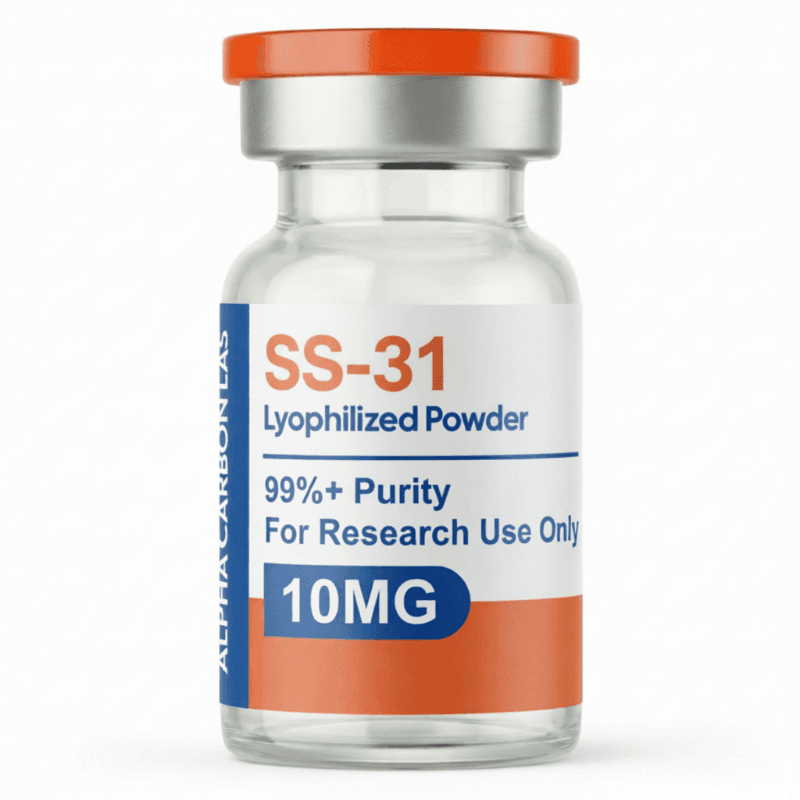
10MG
This product is for research purposes only. Not for human consumption.
Purity: >98% (HPLC verified)
Formulation: Lyophilized powder
Molecular Formula: C32H49N9O5
Molecular Weight: 639.8 g/mol
CAS Number: 736992-21-5
PubChem CID: N/A

SS-31
Overview
SS-31 (Elamipretide, also known as Bendavia, MTP-131, or D-Arg-Dmt-Lys-Phe-NH2) is a novel aromatic-cationic tetrapeptide that represents a first-in-class therapeutic approach targeting mitochondrial dysfunction at the level of the inner mitochondrial membrane.
Developed by Stealth BioTherapeutics, SS-31 is specifically designed to selectively concentrate within mitochondria and bind to cardiolipin, a unique phospholipid that is almost exclusively found in the inner mitochondrial membrane and plays critical structural and functional roles in mitochondrial bioenergetics.
Mitochondrial Dysfunction
Mitochondria serve as the powerhouses of cells, generating the vast majority of cellular ATP through oxidative phosphorylation, but they are also major sources of reactive oxygen species (ROS) and play central roles in cellular signaling, calcium homeostasis, and programmed cell death pathways.
Mitochondrial dysfunction - characterized by impaired ATP production, excessive ROS generation, disrupted membrane potential, and dysregulated cellular signaling - is increasingly recognized as a key contributor to numerous diseases including heart failure, ischemia-reperfusion injury, neurodegenerative diseases, mitochondrial myopathies, kidney disease, and even aging itself.
A Novel Approach
Traditional antioxidants have largely failed to show clinical benefits for mitochondrial diseases, likely because they do not specifically accumulate in mitochondria at sufficient concentrations or because simple ROS scavenging does not address the underlying mitochondrial structural and functional abnormalities.
SS-31 represents a fundamentally different approach: rather than attempting to neutralize ROS after they are produced, it stabilizes the structure and function of the inner mitochondrial membrane, thereby preventing excessive ROS production at the source while simultaneously optimizing ATP synthesis efficiency.
The peptide's unique alternating aromatic-cationic structure (containing aromatic residues dimethyltyrosine and phenylalanine alternating with cationic residues arginine and lysine) allows it to readily cross cellular and mitochondrial membranes and selectively bind to cardiolipin without requiring specialized delivery systems.
By stabilizing cardiolipin and the protein complexes of the electron transport chain that depend on cardiolipin for proper organization and function, SS-31 enhances mitochondrial efficiency, reduces electron leak and ROS production, maintains mitochondrial membrane potential, prevents cytochrome c release (which would trigger apoptosis), and ultimately preserves cellular energetics and viability under conditions of metabolic stress.
The peptide has progressed through extensive preclinical research and multiple clinical trials, achieving orphan drug designation from the FDA for Barth syndrome (a rare genetic mitochondrial disease) and primary mitochondrial myopathy, and has been evaluated in Phase II and Phase III trials for heart failure and other conditions.
Mechanism of Action
SS-31 functions through a sophisticated mechanism centered on its interaction with cardiolipin, a unique dimeric phospholipid containing four fatty acid chains that constitutes approximately 20% of the lipid content of the inner mitochondrial membrane.
Cardiolipin's Essential Role
Cardiolipin is not merely a structural component; it is essential for the proper organization, stability, and function of the protein complexes of the electron transport chain (ETC) - particularly complexes I, III, IV, and V (ATP synthase) - that are responsible for oxidative phosphorylation and ATP generation.
Cardiolipin provides a unique membrane microenvironment that allows these complexes to associate into larger functional units called supercomplexes or respirasomes, which enhance electron transfer efficiency and reduce electron leak.
Oxidative Damage Cycle
Under conditions of oxidative stress, inflammation, or metabolic dysfunction, cardiolipin molecules can become peroxidized (damaged by ROS), leading to loss of their structural integrity, dissociation of ETC supercomplexes, increased electron leak, and further ROS generation in a vicious cycle.
Damaged cardiolipin also facilitates the detachment of cytochrome c from the inner membrane, which triggers apoptotic pathways and contributes to cell death.
SS-31 Binding and Stabilization
SS-31's alternating aromatic-cationic structure allows it to selectively bind to cardiolipin through electrostatic interactions between its cationic residues and the negatively charged phosphate groups of cardiolipin, combined with hydrophobic interactions involving its aromatic residues.
Remarkably, SS-31 preferentially binds to cardiolipin over other phospholipids due to cardiolipin's unique charge distribution and four-acyl structure, providing specificity for mitochondrial targeting despite the peptide's simple structure.
Once bound, SS-31 stabilizes cardiolipin molecules, protecting them from peroxidative damage and maintaining their proper conformation and function. This stabilization preserves the organization and function of ETC complexes, enhancing their efficiency in electron transfer and ATP synthesis while simultaneously reducing electron leak and ROS generation at complexes I and III - the major sites of mitochondrial ROS production.
Therapeutic Effects
By reducing ROS production at the source rather than simply scavenging ROS after they are generated, SS-31 breaks the cycle of oxidative damage and maintains mitochondrial function even under conditions of metabolic stress.
The peptide also helps maintain mitochondrial membrane potential (the electrochemical gradient across the inner membrane that drives ATP synthesis), prevents the mitochondrial permeability transition (a catastrophic event leading to mitochondrial swelling and cell death), and inhibits cytochrome c release, thereby protecting cells from apoptosis.
Importantly, SS-31 does not directly scavenge ROS (unlike traditional antioxidants), does not inhibit the electron transport chain (which would impair ATP production), and does not accumulate to toxic levels because its binding to cardiolipin is reversible and saturable. The peptide's effects are thus homeostatic - normalizing mitochondrial function without disrupting normal cellular processes.
SS-31 has demonstrated the ability to improve cardiac function in heart failure models, protect against ischemia-reperfusion injury, improve skeletal muscle function in mitochondrial myopathies, and provide neuroprotection in models of neurodegeneration.
Research Findings
Research on SS-31 has progressed from foundational studies elucidating its mechanism of action to extensive preclinical investigations in animal models and multiple clinical trials in human patients with various conditions characterized by mitochondrial dysfunction.
Preclinical Research
Early preclinical work by Szeto, Birk, and colleagues at Cornell characterized SS-31's ability to selectively target mitochondria, bind to cardiolipin, protect against oxidative damage, and improve mitochondrial function across various cell types and tissue models.
Studies in isolated mitochondria demonstrated that SS-31 reduces ROS production, improves respiratory function, and prevents mitochondrial permeability transition. Cell culture studies showed protective effects against oxidative stress, preservation of ATP levels under metabolic stress, and prevention of apoptosis.
Cardiovascular Research
Animal studies have been extensive and compelling across multiple disease models. In cardiovascular research, studies in models of myocardial infarction showed that SS-31 administration reduces infarct size, preserves cardiac function, and improves survival when given before or shortly after ischemic injury.
Heart failure models demonstrated that SS-31 treatment improves cardiac contractility, reduces pathological remodeling, enhances exercise tolerance, and extends survival. Ischemia-reperfusion injury studies showed dramatic protective effects, with SS-31 reducing tissue damage, inflammation, and functional impairment when administered around the time of reperfusion.
Mitochondrial Myopathy and Neurodegeneration
Studies in mitochondrial myopathy models, particularly the Barth syndrome mouse model (which lacks the enzyme tafazzin needed for cardiolipin remodeling), demonstrated that SS-31 treatment improves mitochondrial function, increases exercise capacity, reduces cardiac abnormalities, and extends lifespan - providing strong preclinical rationale for clinical development.
Neurodegenerative disease research has shown protective effects in models of Alzheimer's disease, Parkinson's disease, and other neurodegenerative conditions, with studies demonstrating improved mitochondrial function in neurons, reduced oxidative damage, decreased neuronal death, and in some models, improved cognitive or motor function.
Clinical Development
Clinical development has included multiple trials across different indications. A Phase I trial in healthy volunteers established safety, pharmacokinetics, and initial evidence of target engagement.
Phase II trials in heart failure with preserved ejection fraction (HFpEF) showed promising signals including improvements in exercise capacity and diastolic function parameters. A Phase II trial in Barth syndrome demonstrated improvements in exercise capacity (6-minute walk test distance) and trends toward cardiac function improvements, leading to orphan drug designation.
However, the EMBRACE-HFpEF Phase III trial in heart failure with preserved ejection fraction did not meet its primary endpoint, though post-hoc analyses suggested potential benefits in certain subgroups, highlighting the challenges of targeting heterogeneous patient populations.
Safety data from clinical trials has generally been favorable, with SS-31 demonstrating good tolerability across studied populations. The peptide has a short half-life requiring multiple daily administrations or continuous infusion in some trial designs, which has prompted development of longer-acting formulations.
Research Applications
- Heart failure and cardiac mitochondrial dysfunction research
- Ischemia-reperfusion injury prevention studies
- Barth syndrome and genetic mitochondrial disease research
- Primary mitochondrial myopathy studies
- Neurodegenerative disease (Alzheimer's, Parkinson's) research
- Acute kidney injury and chronic kidney disease studies
- Exercise performance and muscle function research
- Aging and age-related mitochondrial decline research
- Cardiolipin protection and membrane stabilization studies
- Oxidative stress and ROS reduction research
- Cellular bioenergetics and ATP synthesis research
Safety Profile
SS-31 has undergone extensive safety evaluation through multiple Phase I and Phase II clinical trials involving hundreds of patients with various conditions including heart failure, mitochondrial myopathies, and other diseases. These studies have generally demonstrated favorable safety and tolerability profiles. The most commonly reported adverse events in clinical trials have been mild and include injection site reactions (the peptide has been administered subcutaneously and intravenously in various studies), headache, and gastrointestinal symptoms such as nausea or diarrhea, with most adverse events being transient and not leading to discontinuation. No serious safety signals or dose-limiting toxicities have been identified at the doses studied for clinical applications. Because SS-31 works by stabilizing an endogenous molecule (cardiolipin) and optimizing mitochondrial function rather than inhibiting specific pathways, it appears to have a good therapeutic window without major on-target adverse effects. The peptide does not accumulate to toxic levels due to its reversible binding and rapid clearance, and it does not appear to disrupt normal mitochondrial function in healthy tissues. Long-term safety data is still being accumulated, particularly for chronic administration in conditions requiring extended treatment. Theoretical concerns about any mitochondrial-targeted therapy include potential effects on mitochondrial dynamics, mitophagy (the selective degradation of dysfunctional mitochondria), or cellular stress responses, though these have not emerged as clinical concerns in SS-31 trials to date. The peptide has received orphan drug designation from regulatory agencies for Barth syndrome and primary mitochondrial myopathy, indicating regulatory recognition of its potential benefits for these rare, serious conditions with high unmet medical need. Standard precautions regarding peptide therapeutics apply, including considerations for patients with renal or hepatic impairment (though SS-31's rapid metabolism and clearance may limit accumulation concerns), potential for immunogenicity with chronic exposure, and appropriate monitoring during treatment initiation and dose escalation.
Scientific References
Research Use Only
This product is intended for research purposes only and is not for human consumption, therapeutic use, or diagnostic applications. Please ensure compliance with all applicable regulations and institutional guidelines.