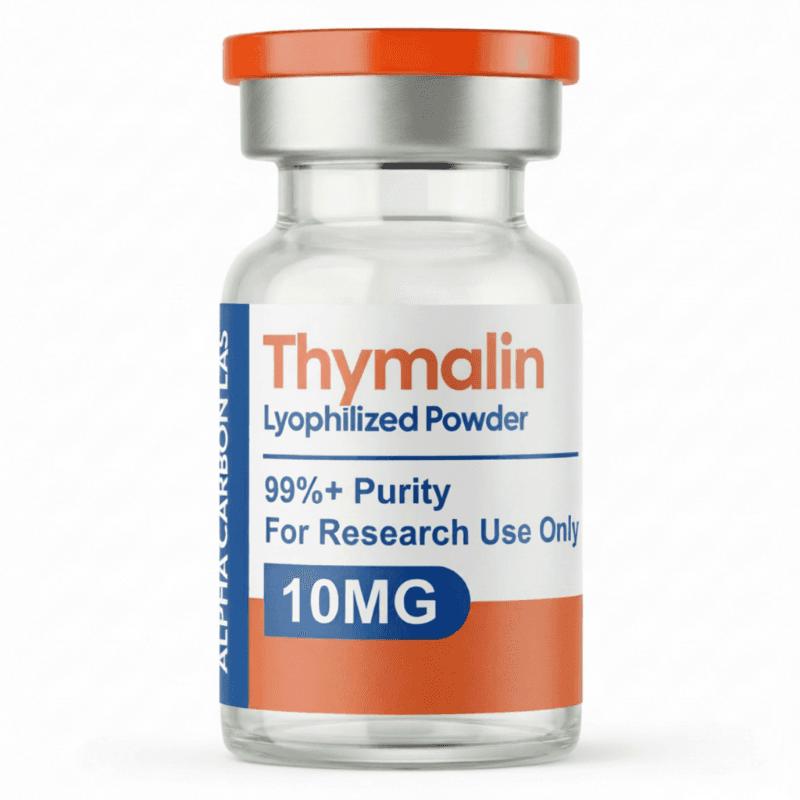
10MG
This product is for research purposes only. Not for human consumption.
Purity: >98% (HPLC verified)
Formulation: Lyophilized powder
Molecular Formula: N/A (Complex peptide mixture)
Molecular Weight: Variable
CAS Number: N/A
PubChem CID: N/A
Thymalin
Overview
Thymalin is a complex polypeptide extract derived from the thymus glands of young cattle, representing one of several thymic peptide bioregulators developed through extensive research in the former Soviet Union and Russia. The thymus gland, located in the upper chest behind the sternum, plays a central role in the development and maturation of T lymphocytes (T cells), which are critical components of the adaptive immune system responsible for cell-mediated immunity, immune surveillance, and coordinated immune responses.
The thymus is most active during childhood and adolescence, gradually involuting (shrinking and becoming less functional) with age in a process called thymic involution, which begins after puberty and accelerates with aging. This age-related decline in thymic function is associated with reduced production of naive T cells, decreased immune diversity, increased susceptibility to infections, higher cancer risk, reduced vaccine responses, and increased autoimmunity - collectively termed immunosenescence.
Thymalin contains a mixture of naturally occurring thymic peptides, including thymulin, thymosin alpha-1, thymosin beta-4, thymopoietin, and other bioactive factors that are secreted by thymic epithelial cells and play crucial roles in T-cell education, selection, and maturation. The extraction and purification process yields a complex but standardized mixture of these peptides, which collectively aim to restore or support thymic function and enhance overall immune system performance.
Research by Khavinson and colleagues at the St. Petersburg Institute of Bioregulation and Gerontology has been central to developing and studying thymic peptide bioregulators including Thymalin, with numerous Russian-language publications and clinical applications documented. While Western scientific literature contains less extensive research on Thymalin specifically compared to isolated thymic peptides like thymosin alpha-1, the accumulated clinical experience in Russia and related countries suggests therapeutic benefits for immune support, particularly in elderly populations and immunocompromised individuals.
Mechanism of Action
Thymalin exerts its immunomodulatory effects through multiple mechanisms reflecting the actions of its constituent thymic peptides on various aspects of immune system development, maturation, and function. The thymus gland's primary function is to provide a specialized microenvironment for T-cell development, a process called thymopoiesis, during which T-cell precursors migrate from bone marrow to the thymus, undergo selection processes that eliminate self-reactive cells (negative selection) and preserve cells with functional T-cell receptors (positive selection), and differentiate into various T-cell subsets including CD4+ helper T cells and CD8+ cytotoxic T cells before being released to the periphery.
Thymic peptides secreted by thymic epithelial cells orchestrate these complex processes through effects on thymocyte proliferation, differentiation, and survival. Thymalin, by providing a mixture of these bioactive thymic peptides, supports T-cell maturation and function through several pathways:
T-Cell Development and Maturation
The peptide complex enhances differentiation of T-cell precursors into mature, functional T lymphocytes, promoting the development of both CD4+ and CD8+ T-cell populations and supporting the generation of naive T cells that can respond to new antigens - a capacity that declines with thymic involution. Thymalin stimulates IL-2 (interleukin-2) production and IL-2 receptor expression on T cells, which is crucial for T-cell proliferation and activation.
Immune Balance and Modulation
The peptide mixture modulates the balance between different T helper cell subsets (Th1, Th2, Th17, and regulatory T cells), promoting appropriate immune responses while preventing excessive or misdirected immunity. Beyond effects on T cells, Thymalin influences other immune components including enhancement of natural killer cell activity (important for antitumor and antiviral immunity), modulation of antibody production by B cells, improvement of macrophage and dendritic cell function, and restoration of normal cytokine production patterns that may become dysregulated with age or disease.
The peptide complex appears to have both immune-enhancing effects when immunity is suppressed and immune-normalizing effects when responses are excessive or misdirected, suggesting true immunomodulatory rather than simply immunostimulatory properties. The complex mixture of peptides in Thymalin is thought to provide synergistic or complementary effects, potentially offering advantages over single purified thymic peptides by more completely recapitulating the thymic microenvironment's regulatory influences.
Research Findings
Research on Thymalin and related thymic peptide extracts has been conducted primarily in Russia and the former Soviet Union, with additional studies from Eastern Europe and Asia, resulting in a substantial body of Russian-language scientific and clinical literature alongside more limited English-language publications. The foundational work was conducted at the St. Petersburg Institute of Bioregulation and Gerontology under the direction of Vladimir Khavinson and colleagues, who systematically studied various peptide bioregulators derived from different organs including the thymus.
Immunological Research
Studies have examined Thymalin's effects on immune parameters, clinical outcomes in various diseases, and potential anti-aging properties. Immunological studies have consistently demonstrated that Thymalin administration can increase peripheral T-cell counts, particularly CD4+ T helper cells, improve T-cell proliferative responses to mitogens (indicating enhanced functional capacity), normalize CD4+/CD8+ T-cell ratios when dysregulated, and enhance delayed-type hypersensitivity responses (a measure of cell-mediated immunity).
Clinical Applications
Clinical studies in elderly populations have reported improvements in immune parameters associated with aging, including increased T-cell counts, improved vaccine responses, reduced incidence and severity of respiratory infections, and subjective improvements in energy and well-being. A study by Anisimov and colleagues published in Mechanisms of Ageing and Development examined Thymalin's effects in aging mice, showing improvements in immune function markers, extension of lifespan, and reduced spontaneous tumor incidence, suggesting potential anti-aging and cancer-preventive effects.
Clinical applications in immunodeficiency states have reported improvements in infection rates, immune reconstitution, and clinical outcomes. Studies in post-surgical patients and those recovering from severe illness have shown that Thymalin administration can accelerate immune recovery, reduce complication rates, shorten hospital stays, and improve overall convalescence.
Research Limitations
Importantly, most Thymalin research has been published in Russian journals or presented at Russian scientific conferences, with limited penetration into mainstream Western medical literature. This creates challenges in evaluating the full scope and quality of the evidence base, as many studies may not meet current international standards for clinical trial design, reporting, and statistical analysis. The lack of large-scale, randomized, placebo-controlled trials published in major international journals means that Thymalin's efficacy and optimal clinical applications remain less well-established in Western medicine.
Research Applications
- Age-related immune decline and immunosenescence research
- Immunodeficiency states and immune reconstitution studies
- Recurrent infection prevention and immune support research
- Post-surgical and post-illness recovery research
- T-cell function restoration and thymopoiesis studies
- Vaccine response enhancement research
- Cancer supportive therapy and immune oncology studies
- Autoimmune disease modulation research
- Chronic viral infection immune support studies
- Anti-aging and longevity research
- Stress resistance and resilience studies
Safety Profile
Thymalin has been used in clinical practice in Russia and related countries for several decades, with accumulated experience suggesting generally favorable safety and tolerability profiles. Being derived from natural thymic tissue rather than being a synthetic compound, and containing peptides that are structurally similar or identical to endogenous human thymic factors, Thymalin is expected to have inherently lower toxicity than many pharmaceutical agents. Clinical experience and published studies report that side effects are generally mild and infrequent, with most patients tolerating the treatment well. The most commonly reported adverse events include mild injection site reactions such as redness, swelling, or tenderness (as Thymalin is typically administered by intramuscular injection), which are transient and resolve without intervention. Rare reports of systemic allergic reactions or hypersensitivity are possible with any biological extract derived from animal sources, though such reactions appear uncommon with Thymalin - likely reflecting thorough purification processes that remove most non-peptide proteins and potential allergens. Some patients may experience mild fatigue or flu-like symptoms shortly after administration, possibly reflecting immune system activation, though these effects are typically short-lived. As an immunomodulatory therapy, theoretical concerns exist regarding potential exacerbation of autoimmune conditions if immune activation becomes misdirected, though clinical experience and some research suggest Thymalin may actually help normalize dysregulated immune responses rather than simply stimulating immunity indiscriminately. The appropriate use in patients with active autoimmune diseases should be carefully considered and monitored. Long-term safety appears favorable based on decades of clinical use, with no significant accumulation toxicity or major adverse effects reported with standard therapeutic courses. Quality and standardization of Thymalin preparations is important, as with any biological extract, to ensure consistent potency, purity, and freedom from contaminants including potential pathogens or prions (particularly relevant for bovine-derived products, though thymus tissue is considered low-risk for prion transmission and manufacturing processes include safety steps). Regulatory status varies by country - Thymalin is approved and available as a pharmaceutical product in Russia and some other countries where it has an established history of use, but it is not approved by Western regulatory agencies such as the FDA or EMA, and is generally available in Western countries only through research or international pharmacy channels. As with other peptide bioregulators without extensive Western clinical trial documentation, comprehensive safety data meeting current international standards remains limited.
Scientific References
Research Use Only
This product is intended for research purposes only and is not for human consumption, therapeutic use, or diagnostic applications. Please ensure compliance with all applicable regulations and institutional guidelines.